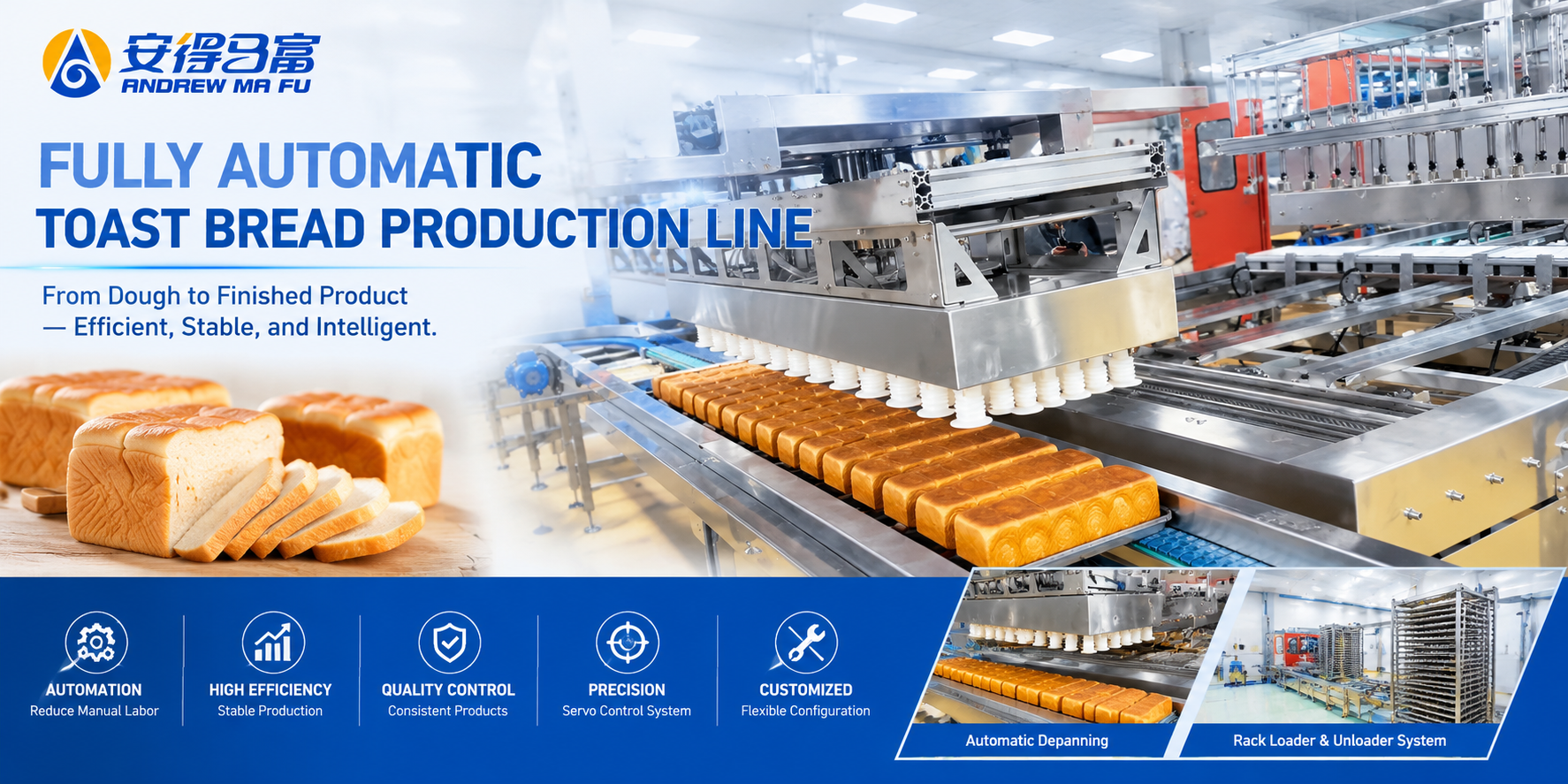
As the industrial bakery industry continues to develop, manufacturers are increasingly looking for ways to improve production efficiency, reduce repetitive manual operations, and achieve more consistent product handling.
While dough mixing, dividing, forming, proofing, and baking are essential stages in bakery production, the processes between baking and downstream packaging also play an important role in overall line performance.
Automatic tray handling and bakery depanning systems can help connect different production stages, providing practical solutions for bakeries seeking to improve their automation capabilities.
Andrew Mafu Machinery provides bakery equipment and customized production solutions, including rack loader and unloader systems, depanner machines, and other bakery automation equipment.
This week’s product focus explores how automated tray handling can support modern bakery production.
1. Why Is Automation Important in Industrial Bakery Production?
In a traditional bakery, operators may manually transfer baking trays between racks, conveyors, ovens, and cooling areas.
As production capacity increases, repetitive handling operations can require more labor and coordination.
Automation can help address these challenges by integrating equipment into a continuous production workflow.
Typical objectives include:
(1)Reducing repetitive manual operations
(2)Improving tray transfer consistency
(3)Supporting continuous production
(4)Optimizing labor allocation
(5)Connecting different production stages
(6)Improving operational control
However, the appropriate automation solution depends on the bakery’s product specifications, equipment layout, production volume, and existing workflow.
A properly designed system should support the complete production process rather than focusing on one machine in isolation.
2. Automatic Bakery Tray Handling Systems
A ADMF Rack Loader & Unloader Systems is designed to automatically load and unload baking trays from racks or trolleys and arrange them onto a conveying line.
This equipment can replace manual tray loading and unloading operations, helping reduce labor requirements and improve the efficiency of tray movement.
For industrial bakeries using rack-based production systems, automated handling can be particularly useful when baking trays need to be transferred repeatedly between different production areas.
Main Functions
Automatic Tray Transfer
The machine handles baking trays according to the programmed operating sequence.
Servo-Controlled Movement
The system uses full servo control to support accurate baking tray movement.
Conveyor Integration
The equipment can be configured to connect with conveying systems according to the bakery layout.
Adjustable Parameters
The man-machine interface allows operating parameters to be adjusted, saved, and read.
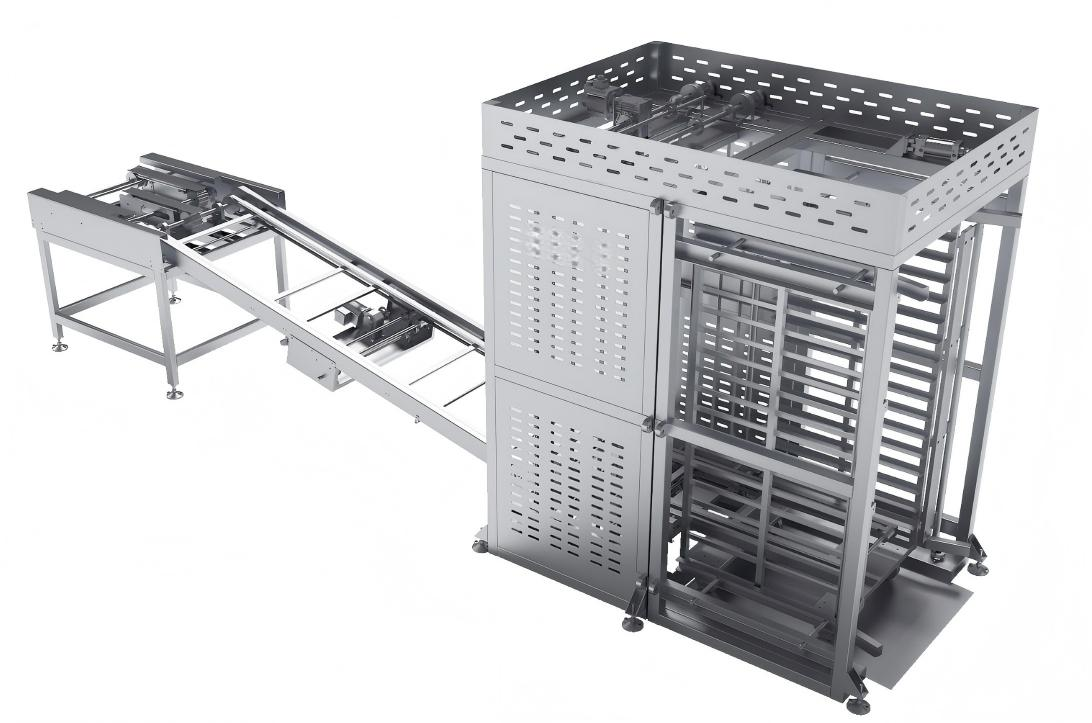
3. ADMF Rack Loader & Unloader Systems: Technical Specifications
The following specifications are based on the current ADMF-SXPJ equipment information.
| Technical Parameter | Specification |
| Modèl | ADMF-SXPJ |
| Operating Speed | 90 seconds per trolley |
| External Dimensions | 5700 × 1350 × 2260 mm |
| Pouvwa | 3 kW |
| Sistèm kontwòl | Full servo control |
| Compatible Tray Sizes | 400 × 600 mm / 600 × 600 mm |
| Tray Configuration | Two beats per session |
| Operation Interface | Man-machine interface |
| Parameter Management | Adjustable, saved, and readable |
| Lijans | Other tray specifications available |
Important: Actual performance depends on tray dimensions, trolley configuration, production layout, and operating conditions.
Andrew Mafu Machinery can evaluate these factors when developing a suitable equipment configuration.
4. From Baking to Depanning: Improving Production Continuity
After baking, bakery products must be transferred from baking trays to the next production stage.
Depending on the product, this may involve cooling, slicing, sorting, or packaging.
Manual depanning can increase labor requirements and introduce variations in product handling.
A ADMF Bakery Depanner Machine is designed to automatically remove baked products from trays using an adsorption mechanism.
The machine is suitable for applications including:
(1)Cup cakes
(2)Bread
(3)Stamped toast
Its main components include a frame, translational driving mechanism, elevator drive mechanism, and adsorption mechanism with a suction nozzle plate.
These components work together to support automatic product removal and transfer.
5. ADMF Bakery Depanner Machine: Technical Specifications
| Technical Parameter | Specification |
| Machine Name | Bakery Depanner Machine |
| Modèl | ADMF-XPTMJ |
| Rated vòltaj | 220 V / 50 Hz |
| Pouvwa | 3.7 kW |
| Dimensions | 1744 × 1020 × 1622 mm |
| Pwa | 600 kg |
| Kapasite | 4 times/minute |
| Adsorption System | Suction nozzle plate |
| Application | Cup cake, bread, stamped toast |
The final suitability of the depanner should be assessed according to product size, weight, shape, surface characteristics, and tray configuration.
Product testing and technical confirmation are important steps before finalizing an equipment solution.
6. How Tray Handling Supports Bakery Automation
A bakery production line often includes several interconnected stages.
For example:
Dough Processing → Forming → Tray Arranging → Proofing → Baking → Tray Handling → Depanning → Cooling → Packaging
Each stage must work in coordination with the others.
When tray loading, unloading, and product removal are automated, the bakery can reduce dependence on repetitive manual operations.
However, automation performance depends on the complete line design.
Important factors include:
Kapasite pwodiksyon
The equipment must be compatible with the required production rate and operating rhythm.
Tray Dimensions
Tray size affects handling mechanisms, conveyor arrangements, and machine configuration.
Product Characteristics
Product weight, shape, and structure influence depanning requirements.
Factory Layout
The position of ovens, racks, conveyors, cooling systems, and packaging equipment affects the integration design.
Sistèm kontwòl
Machine control and parameter adjustment should support the intended production workflow.
7. Benefits of Automatic Tray Handling
Reduced Repetitive Labor
Automatic handling can replace certain manual tray transfer operations.
Improved Production Organization
A more coordinated tray movement process can support smoother production flow.
Consistent Handling
Automated movement helps reduce variations associated with manual tray positioning.
Better Equipment Integration
Tray handling systems can be designed to connect different stages of a bakery production line.
Flexible Project Configuration
Equipment selection can be adapted to the customer’s tray specifications, production requirements, and factory layout.
The actual benefits depend on the application and the degree of automation implemented.
8. Choosing the Right Bakery Automation Equipment
Before investing in bakery automation equipment, manufacturers should evaluate their specific production needs.
Andrew Mafu Machinery recommends considering the following technical information:
| Evaluation Factor | Why It Matters |
| Product Type | Determines handling and depanning requirements |
| Product Weight | Influences equipment suitability |
| Tray Dimensions | Affects tray handling configuration |
| Kapasite pwodiksyon | Determines required operating speed |
| Existing Equipment | Supports integration planning |
| Factory Layout | Influences machine positioning |
| Nivo automatisation | Defines the scope of system integration |
| Future Expansion | Helps support long-term planning |
A clear technical evaluation helps ensure that the selected equipment is compatible with the bakery’s production environment.
9. Andrew Mafu Machinery: Your Bakery Equipment Partner
Andrew Mafu Machinery focuses on bakery machinery and customized production solutions for industrial bakery applications.
Our product range includes:
(1)Bread production lines
(2)High moisture bread production solutions
(3)Croissant forming lines
(4)Dough processing equipment
(5)Filling and depositing machines
(6)Rack loader and unloader systems
(7)Bakery depanner machines
(8)Tray handling and conveying equipment
(9)Customized bakery automation solutions
Our engineering approach focuses on understanding each customer’s production requirements and developing equipment configurations suited to their application.
For projects involving tray handling, depanning, or complete bakery production lines, technical information such as product specifications, tray dimensions, production capacity, and factory layout helps support the equipment evaluation process.
10. Conclusion
Bakery automation solutions can help industrial bakeries improve the organization and efficiency of their production processes.
Automatic tray loader and unloader systems support the movement of baking trays, while depanner machines help transfer finished bakery products to downstream processes.
The ADMF-SXPJ Rack Loader & Unloader Systems and ADMF-XPTMJ Bakery Depanner Machine are designed for specific tray handling and depanning applications.
By evaluating product characteristics, production capacity, equipment compatibility, and factory layout, bakeries can develop automation solutions that better match their operational needs.
Andrew Mafu Machinery continues to provide bakery equipment and customized automation solutions for customers seeking to improve their industrial bakery production systems.
Contact our team to discuss your bakery equipment requirements.
Frequently Asked Questions
1. What is bakery automation?
Bakery automation refers to the use of machinery and integrated control systems to automate production processes such as dough handling, forming, tray movement, depanning, and conveying.
2. What does a rack loader and unloader system do?
It automatically loads or unloads baking trays from racks or trolleys and transfers them to a conveying line.
3. What tray sizes does the ADMF-SXPJ support?
The standard specifications include 400 × 600 mm and 600 × 600 mm baking trays. Other specifications can be customized.
4. What products can the ADMF depanner handle?
The ADMF-XPTMJ Bakery Depanner Machine is suitable for cup cakes, bread, and stamped toast applications.
5. Can bakery automation equipment be customized?
Yes. Equipment configuration can be evaluated according to product specifications, tray dimensions, production capacity, and factory layout.
6. What information is needed for a bakery automation project?
Important information includes product type, product weight, tray size, required capacity, existing equipment, and factory layout.
References:
- Andrew Mafu Machinery Official Website
Visit Andrew Mafu Machinery - American Society of Baking
American Society of Baking - AIB International
AIB International - European Hygienic Engineering & Design Group (EHEDG)
EHEDG Official Website - International Organization for Standardization (ISO)
ISO Official Website

Pa ADMF