As global consumer demand shifts toward softer textures, artisan-style products, and premium bread varieties, industrial bakeries are increasingly turning to high hydration dough formulations. However, while high water-content dough improves crumb structure and flavor development, it presents significant challenges in industrial production.
This is where high hydration dough automation becomes critical.
Modern bakeries are no longer simply looking for forming equipment — they require fully integrated automation systems capable of handling sticky, delicate, and structurally unstable dough without compromising consistency or production efficiency.
This article explores the future of high hydration dough automation, the engineering challenges of sticky dough handling, and how advanced sticky dough processing line technology is redefining industrial bakery production.
Why High Hydration Dough Is Transforming Industrial Baking
High hydration dough typically contains 70% or more water relative to flour weight. This results in:
- Improved crumb softness
- Enhanced fermentation activity
- Better flavor development
- Extended product freshness
However, the same properties that enhance product quality also create mechanical instability during automated production.
- Excess stickiness during conveying
- Dough deformation during shaping
- Inconsistent weight control
- Adhesion to molds and trays
- Difficulty in demolding
Traditional bread production lines struggle under these conditions. Manual intervention increases. Production rhythm becomes unstable.
The solution lies in engineering-driven sticky dough processing line automation.
To successfully automate high hydration dough, equipment must address four technical variables:
1. Dough Flow Control
High water content reduces structural rigidity. Equipment must gently guide dough through forming processes without excessive compression.
2. Anti-Adhesion Surface Engineering
Special surface coatings, optimized belt materials, and precise tension control prevent dough accumulation.
3. Synchronization Between Modules
Unstable dough requires accurate speed matching between mixer discharge, forming, tray loading, and transfer systems.
4. Temperature & Fermentation Stability
Hydration impacts fermentation behavior. Automated systems must maintain consistent environmental conditions to avoid over-expansion or collapse.
Technical Overview: High Hydration Dough Automation Line
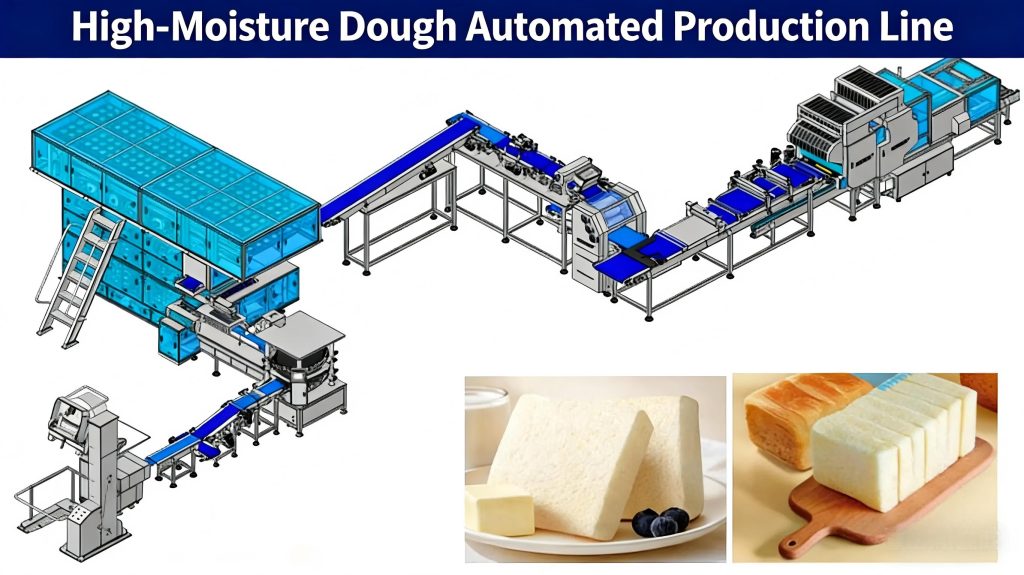
Below is a structural overview of a modern high hydration dough automation system used in industrial bakeries.
High Hydration Dough Automation Line – Technical Overview
| Item | Specification |
| Application | High Hydration Toast, Artisan Bread, Soft Sandwich Loaves |
| Hydration Range | 70% – 85% |
| Nivo automatisation | Fully Automatic Integrated Production Line |
| Sistèm kontwòl | PLC + Industrial HMI Interface |
| Production Mode | Continuous Industrial Operation |
| Surface Treatment | Anti-adhesion belt and mold systems |
| Integration Scope | Mixer + Forming + Tray Handling + Demolding + Return Line |
Core Modules of a Sticky Dough Processing Line
Automation is not just one machine — it is an integrated system.
Core Modules in a Sticky Dough Processing Line
| Module | Fonksyone |
| Industrial Spiral Mixer | Uniform gluten development and hydration control |
| Gentle Forming Unit | Low-pressure shaping to preserve dough structure |
| Automatic Tray Arrangement Machine | Precise placement of sticky dough portions |
| Controlled Proofing Interface | Maintains temperature and humidity stability |
| Automated Demolding System | Ensures safe product release without deformation |
| Closed-Loop Tray Return Line | Continuous production synchronization |
Automation vs Traditional High Hydration Production
The contrast between manual and automated production is significant.
Automation Comparison: Traditional vs Automated Processing
| Traditional Method | High Hydration Dough Automation |
| Frequent manual adjustment | Stable PLC-controlled operation |
| High product variability | Consistent weight and shape control |
| Sticky surface accumulation | Engineered anti-adhesion systems |
| Irregular production rhythm | Continuous synchronized processing |
| Higher labor costs | Reduced labor dependency |
The Future of High Hydration Dough Automation
Looking forward, several trends are shaping the future of high hydration dough automation:
1. Intelligent Dough Monitoring
Sensors measuring moisture levels and elasticity will allow real-time adjustments.
2. Advanced Anti-Stick Materials
Next-generation conveyor materials will further reduce dough adhesion.
3. AI-Based Synchronization
Adaptive production speeds based on dough consistency data.
4. Modular Expansion
Production lines designed for capacity scaling without system replacement.
Industrial bakeries that adopt automation early will gain:
- Higher output stability
- Better product uniformity
- Improved operational cost control
- Stronger competitive positioning
The era of manual high hydration handling is ending.
Automation is no longer optional — it is strategic.
FAQ – High Hydration Dough Automation
1. What hydration level requires specialized automation?
Dough exceeding 70% hydration typically requires specialized sticky dough processing line equipment due to reduced structural stability.
2. Can existing bread production lines handle sticky dough?
Traditional lines may struggle without anti-adhesion upgrades and synchronization adjustments.
3. How does automation prevent dough sticking?
Through engineered surface materials, belt design optimization, and precise speed coordination.
4. Is high hydration automation suitable for sandwich bread?
Yes. It is commonly used in soft sandwich and toast bread production.
5. Does automation affect product texture?
When properly engineered, automation preserves dough structure while improving consistency.
References & Sources
References & Sources
- Industrial Bread Production Trends,Bake Magazine
- Automation in Food Manufacturing,Food Processing Industry Report
- Hydration and Gluten Development Research,ScienceDirect
- Andrew Mafu Machinery – High Hydration Processing Solutions,Official Website