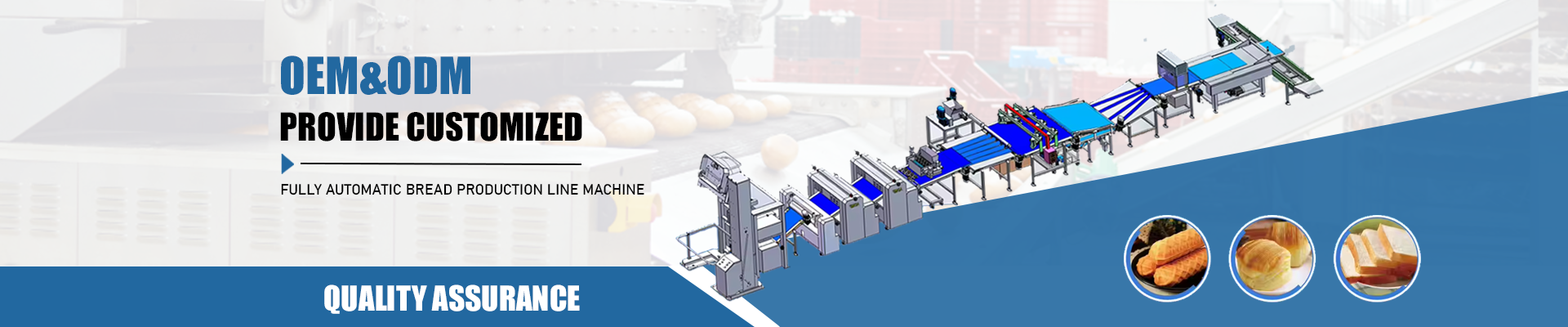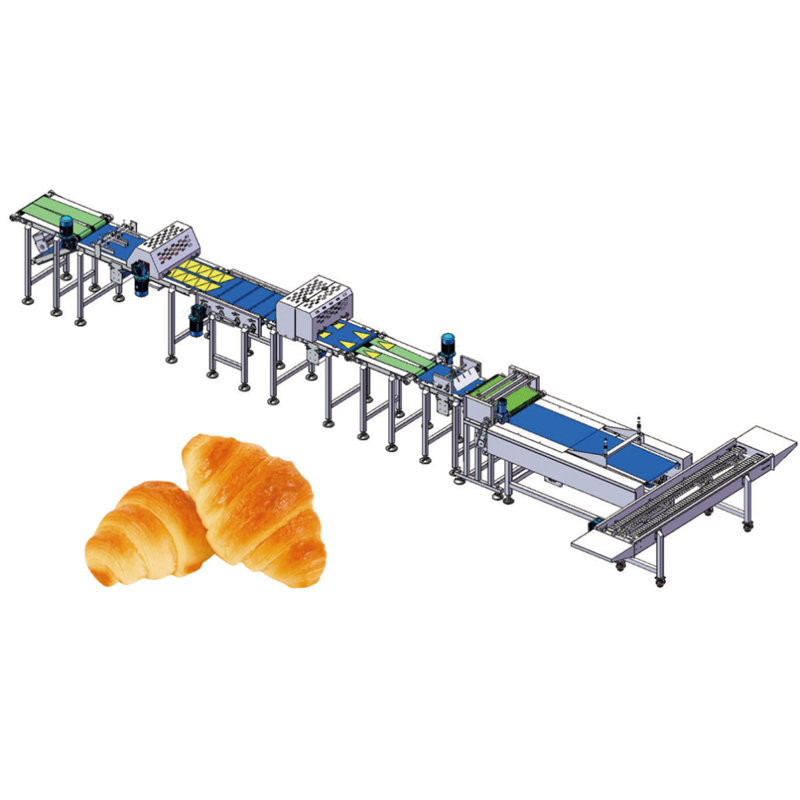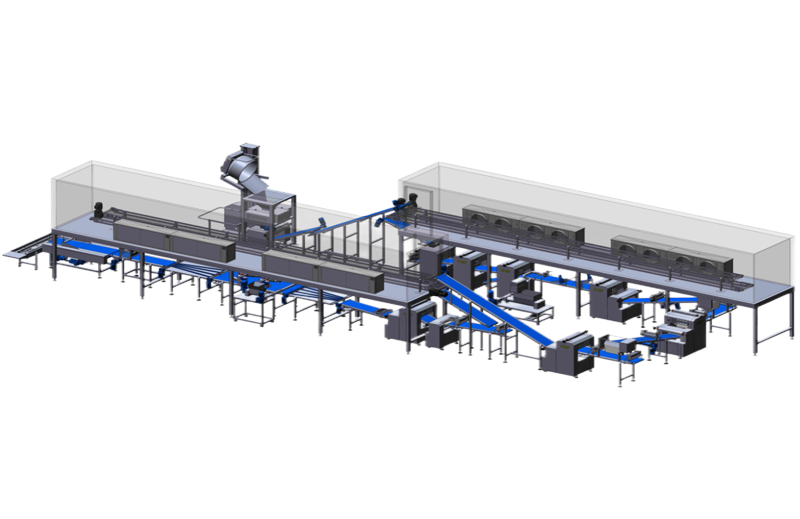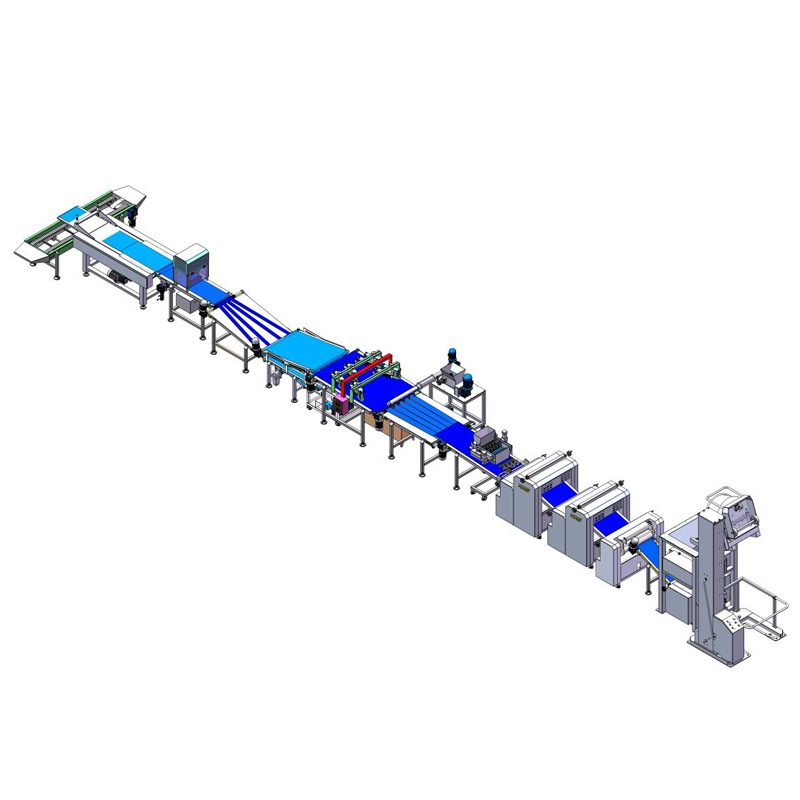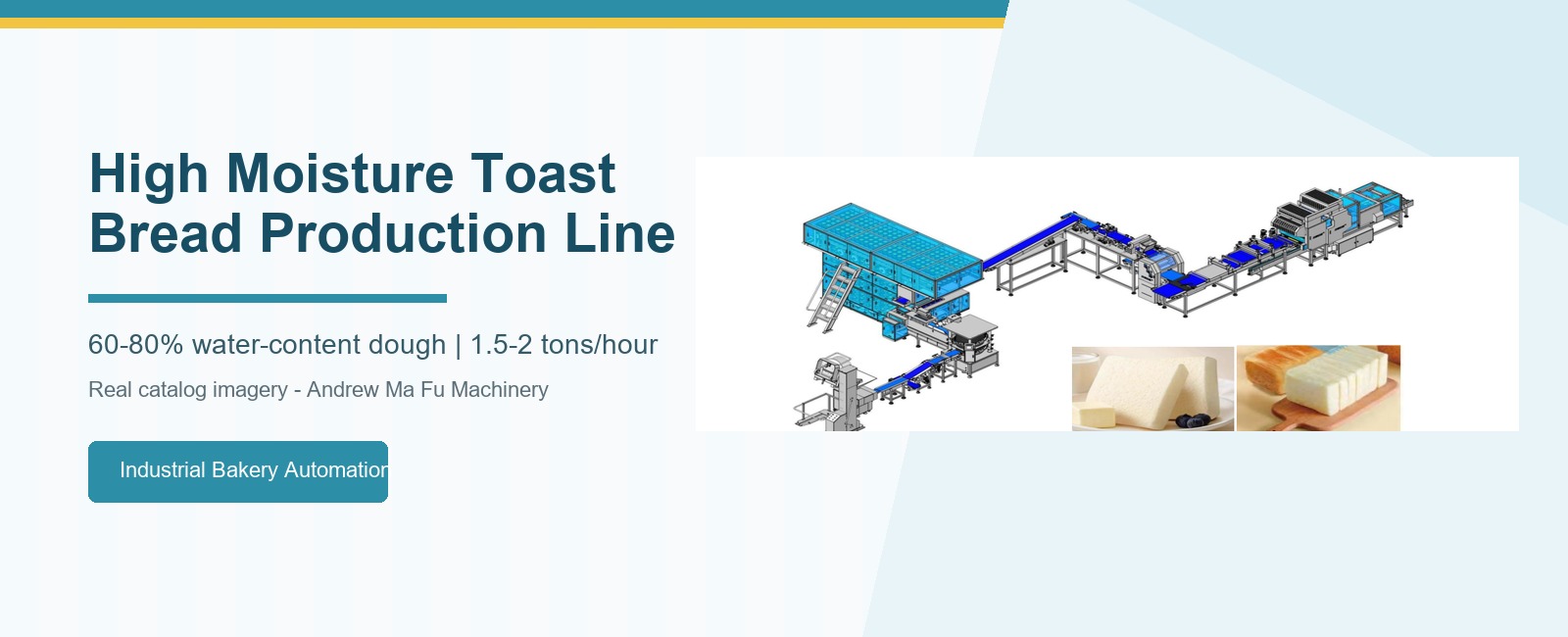
High-moisture toast has become a strategic product category for bakeries that need a soft crumb, clean slice structure, and consistent eating quality across every batch. The challenge is not simply adding more water to the formula. Dough with 60-80% water content is sticky, sensitive to handling, and easy to deform when the production process relies heavily on manual transfer. For industrial manufacturers, this creates a direct need for a controlled high moisture toast bread line that can divide, round, relax, sheet, fold, and arrange dough with repeatable accuracy.
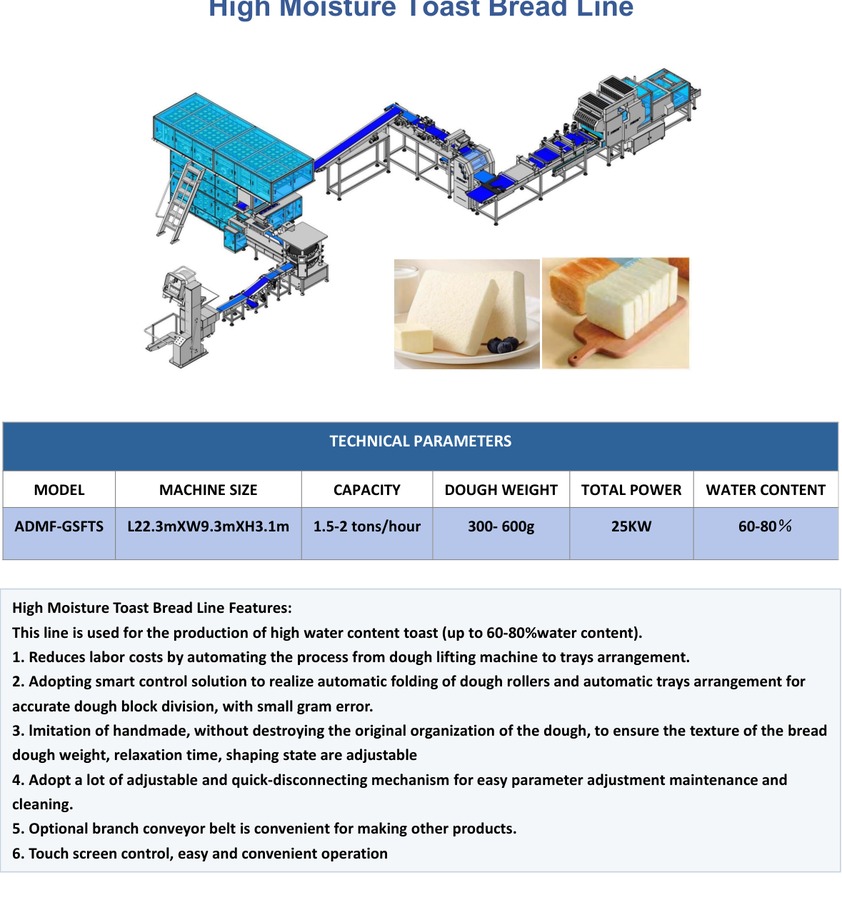
Andrew Mafu Machinery has developed a dedicated solution for this production scenario. Based on the 2026 ADMF production line machinery catalog, the ADMF-GSFTS high moisture toast bread line is designed for dough with 60-80% water content and a production capacity of 1.5-2 tons per hour. The system covers the process from dough lifting and dividing to dough relaxing, roller sheeting, M-shape folding, and tray arranging. For bakeries producing premium toast, milk bread, sandwich bread, and soft sliced bread, this type of line helps reduce dependence on manual shaping while protecting the texture of the dough.
This week’s news focuses on the high moisture toast line rather than seasonal pastry equipment. It is a core bread solution that aligns with Andrew Mafu Machinery’s long-term product direction: automatic bread production, stable dough handling, and practical bakery automation for global food manufacturers.
Why High-Moisture Toast Needs a Dedicated Production Line
High-moisture toast dough behaves differently from standard bread dough. It requires enough hydration to create a soft, elastic crumb, but that same hydration makes the dough difficult to control. Manual handling can cause uneven dough blocks, unstable shape, inconsistent proofing, and unnecessary labor pressure. In factories where output, hygiene, and repeatability matter, these variables become production risks.
A dedicated high moisture toast production line addresses this issue through sequential automation. Instead of moving dough from one isolated machine to another, the line organizes the workflow into connected modules. Each section has a clear function: dough is lifted, divided, rounded, relaxed, sheeted, folded, aligned, and arranged before moving to the next production stage. The objective is not to replace baking expertise, but to make the mechanical steps more stable and measurable.
Andrew Mafu Machinery positions this line for factories that need industrial output without ignoring dough structure. According to the catalog, the system imitates handmade processing where necessary and avoids destroying the original organization of the dough. For buyers evaluating a new automatic bread production line, this is a critical distinction. Speed matters, but the machine must also protect dough relaxation, shaping accuracy, and final bread texture.
Key Process Flow: From Dough Lifting to Tray Arranging
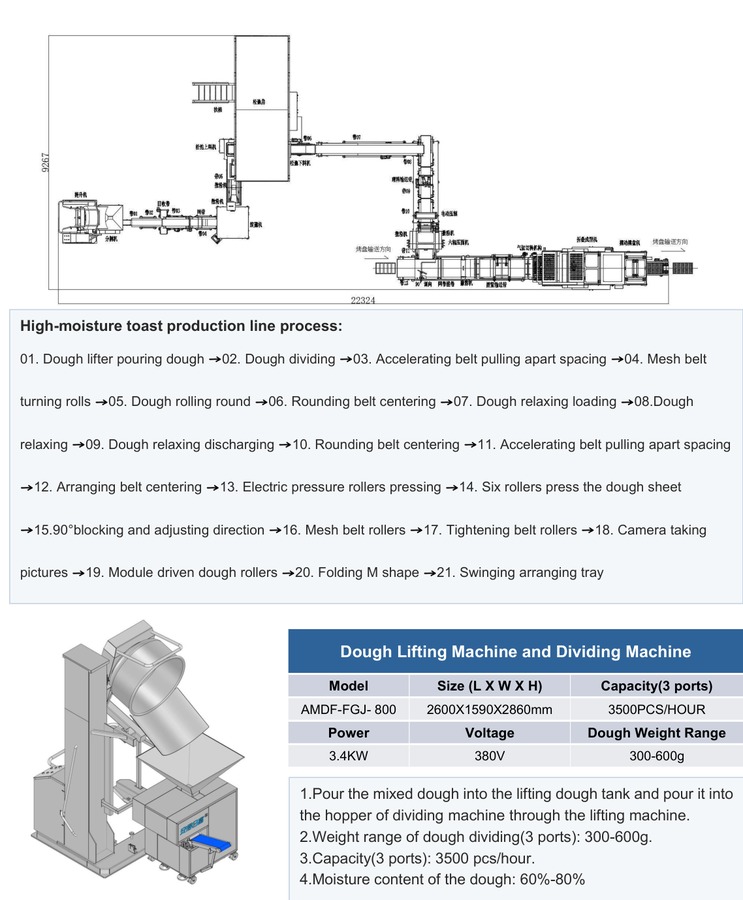
The catalog describes a complete high-moisture toast production process. It begins with dough lifting, where mixed dough is transferred into the hopper of the dividing machine. This reduces physical labor and helps maintain a cleaner, more controlled feeding process. The dough then enters the dividing system, where 300-600 g dough blocks can be processed according to product requirements.
After dividing, the dough passes through rounding and centering sections. These steps are important because high-water dough can easily lose shape if the transfer is not stable. The line uses cylindrical and conical rounding modules to form more consistent dough portions. The dough then moves into a relaxation chamber. According to the catalog, the relaxation chamber can be configured with 218 mesh basket racks, each rack with 6 mesh baskets, for a total of 1,308 mesh baskets. The relaxation time can be adjusted according to the customer’s product needs, with relaxation up to 20 minutes.
After relaxation, dough enters the sheeting and shaping section. The six-roller dough sheeter presses dough into sheets, while the dough centering and alignment system prepares the dough for stable entry into the six-roller press. The following rolling, twisting, and folding modules help create the required shape for toast production. The M-shape dough folding and tray arranging machine then folds dough into M-shape and arranges it into trays. This stage is especially relevant for factories where tray placement previously required repeated manual handling.
Technical Parameters from the 2026 ADMF Catalog
The following parameters are taken from the 2026 Andrew Mafu Machinery production line catalog and should be treated as reference parameters. Final configuration should be confirmed according to customer samples, factory layout, dough formula, and production targets.
Functional Advantages for Industrial Bakeries
The value of the ADMF-GSFTS line is not limited to one machine. It comes from the coordination of all sections. The dough lifting and dividing machine helps pour mixed dough into the dividing hopper with less manual effort. The rounding system supports more uniform dough shaping, while adjustable baffle spacing allows the machine to adapt to different product specifications. The relaxation chamber is designed with quick-disassembly mesh baskets, making the cleaning process more convenient for daily factory operation.
The six-roller dough sheeter uses three pairs of pressure rollers controlled individually. This allows the stretching state of the dough sheet to be managed more flexibly. For high-moisture dough, controlled sheeting is important because excessive mechanical stress can damage the dough surface or create unstable thickness. The catalog also notes that the frame is made of 304 stainless steel and the pressure roller is made of PE, indicating a practical focus on food-contact durability and maintenance.
The M-shape folding and tray arranging section supports automatic completion of roller folding and tray arranging, helping bakeries reduce repetitive labor. For a factory manager, this matters because the final tray arrangement stage is often where bottlenecks appear. When labor is inconsistent or when product flow is not synchronized with upstream equipment, production speed becomes unstable. A connected industrial bread line improves flow from one stage to the next.
How This Line Fits Broader ADMF Bread Automation
Andrew Mafu Machinery also provides broader bread automation solutions for different bakery scales. The company’s Liy pwodiksyon pen otomatik page lists the ADMF-400-800 model with 1-2 tons/hour capacity, L21 m x 7 m x 3.4 m machine size, and 82.37 kW total power. The same website also presents Liy pwodiksyon pen senp for smaller and medium-scale bakeries, with ADMFLINE-002 offering 0.5-1 t/hour capacity and a 20 kW total power configuration.
Compared with a general automatic bread production line, the high moisture toast bread line is more specialized in handling high-water-content dough before baking. It focuses on the preparation and shaping process where sticky dough requires controlled transfer, relaxing, pressing, and arranging. For manufacturers that also produce sandwich bread or sliced toast products, the line can be connected with downstream equipment such as bread slicing, toast peeling, feeding conveyor, filling, and cutting machines. ADMF’s Sandwich Bread Production Lines provide an example of how toast-based products can move further into value-added processing.
This modular thinking is important for international buyers. A bakery may begin with toast production and later add slicing, sandwich filling, pocket bread forming, or packaging automation. Andrew Mafu Machinery can support this staged investment approach by matching equipment according to layout, capacity, and product type.
Applications: Premium Toast, Milk Bread, Sandwich Bread and Soft Loaf Products
The high moisture toast line is suitable for producers targeting soft bread categories that require stable dough structure and clean product appearance. Typical applications include high-moisture toast, milk bread, sandwich bread, packaged sliced bread, and soft loaf products. These categories are used in retail bakeries, central kitchens, supermarket suppliers, hotel foodservice, and industrial frozen or chilled bakery operations.
For procurement managers, the decision is not only about output. They must consider product consistency, labor availability, cleaning routines, after-sales support, spare parts, and future expansion. Andrew Mafu Machinery brings more than 15 years of bakery food production and development experience, a 20,000 square meter modernized production base, and a technical service team of more than 100 people. The company serves customers across 120+ countries and regions, giving international buyers a practical manufacturing partner for long-term production upgrades.
Andrew Mafu Machinery recommends that buyers provide product samples, target dough weight, expected water content, workshop layout, and daily output requirements before final line confirmation. These details help engineers evaluate machine configuration, relaxation time, tray arrangement method, and downstream equipment connection.
Conclusion: A Practical Route to Stable High-Moisture Toast Production
High-moisture toast production requires more than a standard bread line. It requires a workflow that respects dough behavior while giving factories the automation needed for scale. The ADMF-GSFTS high moisture toast bread line provides a structured solution from dough lifting and dividing to relaxation, sheeting, folding, and tray arranging. With 1.5-2 tons/hour capacity and equipment designed for 60-80% water-content dough, it gives bakeries a practical route to consistent soft bread production.
For factories planning to upgrade toast, milk bread, or sandwich bread production, Andrew Mafu Machinery can provide configuration discussion, sample-based evaluation, and factory visit support. To discuss your project, contact Andrew Mafu Machinery at [email protected] or submit an inquiry through the official website contact page.
FAQ
-
What products can the high moisture toast bread line produce?
It is designed for high-moisture toast, milk bread, sandwich bread, and other soft loaf products that require stable dough handling and tray arranging.
-
What is the reference capacity of the ADMF-GSFTS line?
According to the 2026 ADMF catalog, the reference capacity is 1.5-2 tons per hour. Final capacity depends on dough formula, product weight, and line configuration.
-
What dough water content can this line handle?
The catalog lists the line for dough with 60-80% water content, making it suitable for soft, high-hydration toast products.
-
Can the dough weight be customized?
Yes. The reference dough range is 300-600 g for several key modules, but final settings should be confirmed according to the customer’s product sample and production requirement.
-
Does the line include dough relaxing?
Yes. The dough relaxation chamber supports controlled relaxation, with relaxation time adjustable according to production needs.
-
Can this line connect with slicing or sandwich production equipment?
Yes. It can be planned with downstream equipment such as bread slicing, toast peeling, feeding conveyor, filling, cutting, and packaging machines according to the factory layout.
-
What information should buyers provide before requesting a quotation?
Buyers should provide product photos or samples, target dough weight, water content, hourly capacity, workshop dimensions, power requirements, and downstream packaging or slicing plans.
-
How can I visit or contact Andrew Mafu Machinery?
Buyers can contact [email protected] or visit the official contact page to arrange technical communication or a factory visit.
References
- FAO Food Safety and Quality
- Codex Alimentarius
- U.S. FDA Food
- Bakerpedia Baking Industry Knowledge
- AIB International
- EHEDG Hygienic Engineering and Design
- Andrew Mafu Machinery Automatic Bread Production Lines
- Andrew Mafu Machinery Sandwich Bread Production Lines

Pa ADMF