As the global bakery industry continues to modernize, croissants remain one of the most popular laminated pastry products in both retail bakeries and large-scale industrial production. Their distinctive flaky texture and rich butter layers require precise processing techniques, which makes croissant manufacturing one of the most technically demanding operations in industrial baking.
To meet growing consumer demand and improve production efficiency, many bakeries are investing in fully automatic croissant production lines. However, choosing the right system requires careful evaluation of several technical factors, including dough lamination technology, production capacity, automation level, and equipment reliability.
This guide explains how bakeries can select the most suitable croissant production line manufacturer and ensure their investment supports long-term production growth.
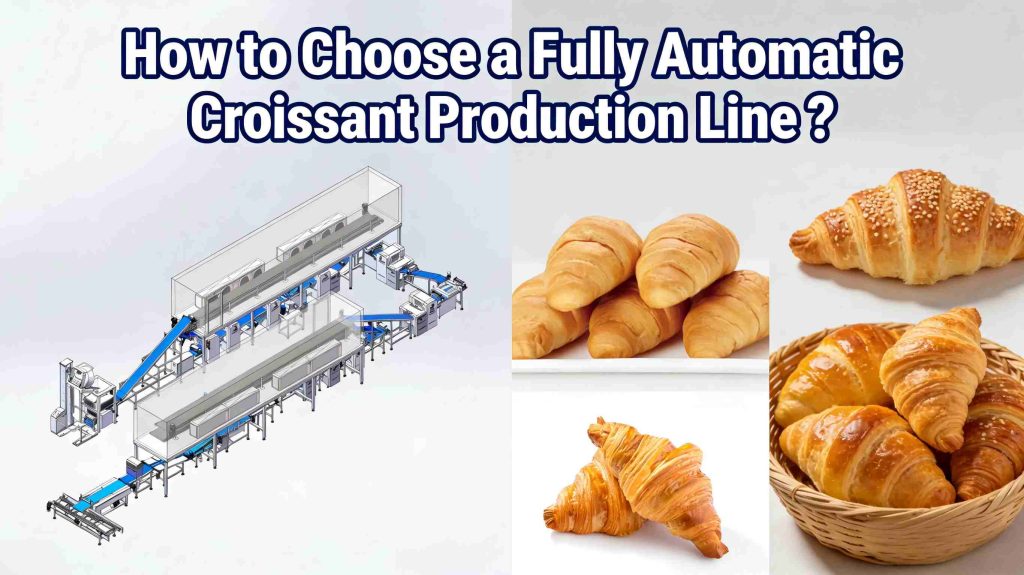
Understanding Croissant Production Technology
Croissants are produced using laminated dough, which involves repeatedly folding butter layers into dough to create hundreds of thin layers. During baking, these layers expand and create the characteristic flaky structure.
The key processes in croissant production include:
-
Dough mixing
-
Dough resting and fermentation
-
Butter block preparation
-
Dough lamination and sheeting
-
Cutting triangular dough pieces
-
Rolling and forming croissants
-
Tray arrangement and proofing
-
Baking and cooling
While traditional bakeries perform these steps manually, industrial bakeries rely on automated laminated dough production systems to maintain consistent product quality while increasing production capacity.
Why Industrial Bakeries Are Adopting Automated Croissant Production
The transition from manual croissant production to automated production lines is driven by several factors.
1. Increasing Market Demand
Croissants are widely consumed in supermarkets, cafés, and convenience stores around the world. Industrial bakeries must produce thousands of units per hour to meet this demand.
2. Labor Cost Reduction
Manual croissant shaping requires skilled workers. Automated systems significantly reduce labor requirements.
3. Product Consistency
Automated machines ensure consistent dough thickness, butter distribution, and croissant shape.
4. Production Efficiency
Automated systems enable continuous production with minimal downtime.
These benefits make automated croissant production lines a key investment for modern bakery manufacturers.
Key Components of a Fully Automatic Croissant Production Line
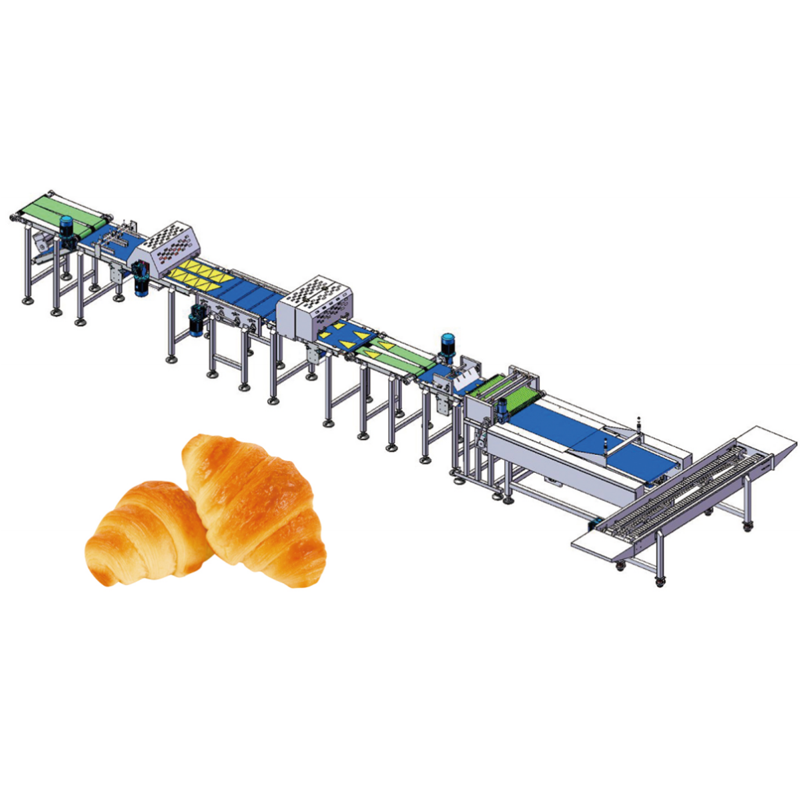
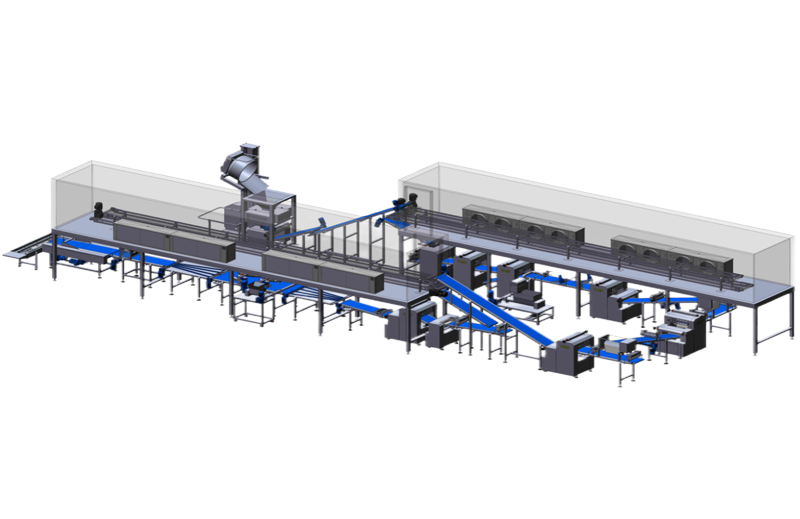
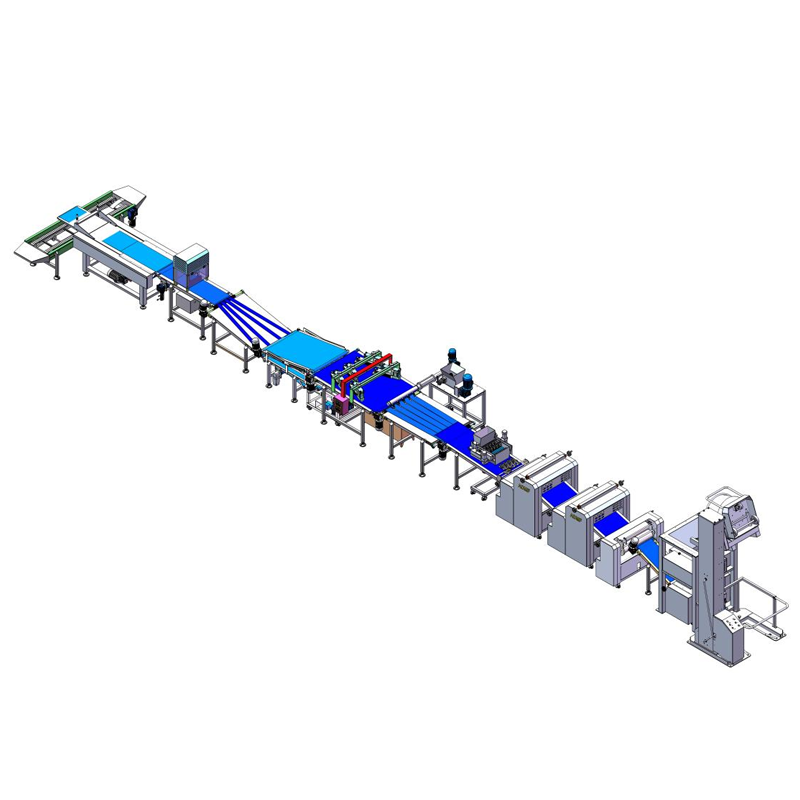
A modern croissant production line typically consists of several integrated modules.
| Equipment Module | Fonksyone |
| Spiral Dough Mixer | Ensures uniform dough mixing and gluten development |
| Laminating Machine | Creates multiple butter layers within the dough |
| Dough Sheeter | Controls dough thickness for consistent lamination |
| Croissant Cutting Unit | Cuts triangular dough pieces accurately |
| Rolling & Forming Machine | Rolls dough triangles into croissant shapes |
| Tray Arrangement Machine | Places formed croissants onto baking trays |
| Proofing System | Controls fermentation temperature and humidity |
| Industrial Oven | Bakes croissants evenly |
| Cooling Conveyor | Stabilizes products before packaging |
These integrated machines form a laminated dough production system capable of producing large quantities of croissants with consistent quality.
Technical Parameters of a Croissant Production Line
Below is a typical configuration for a fully automated croissant production system used in industrial bakeries.
| Paramèt | Specification |
| Kapasite pwodiksyon | 4,000 – 12,000 croissants per hour |
| Dough Thickness Range | 3 – 20 mm |
| Laminating Layers | Up to 144 layers |
| Conveyor Speed | Adjustable 0.5 – 5 m/min |
| Dough Weight Accuracy | ±2% |
| Power Supply | 380V / 50Hz |
| Installed Power | 80 – 150 kW |
| Sistèm kontwòl | PLC + HMI Touch Screen |
| Machine Length | 25 – 40 meters |
| Materyo | Food-grade stainless steel |
These parameters may vary depending on production scale and product specifications.
Key Factors When Choosing a Croissant Production Line Manufacturer
Selecting the right equipment supplier is essential for long-term production stability.
1. Experience in Laminated Dough Technology
Croissant production requires advanced laminated dough processing expertise. Manufacturers with extensive experience in laminated dough systems are more likely to deliver reliable equipment.
2. Automation Integration Capability
A good production line should integrate multiple modules into one continuous process, including mixing, lamination, forming, tray handling, and baking.
3. Production Capacity Flexibility
Industrial bakeries may need scalable systems capable of expanding production capacity in the future.
4. Hygiene and Food Safety Design
Machines should comply with international food safety standards and be easy to clean and maintain.
5. After-Sales Support
Reliable technical support, installation services, and spare parts supply are critical for minimizing production downtime.
Manufacturers such as Andrew Mafu machin provide integrated bakery automation solutions designed specifically for large-scale industrial bakeries.
Advantages of a Fully Automatic Croissant Production Line
Investing in automated croissant production equipment provides several operational benefits.
Consistent Product Quality
Automation ensures uniform dough thickness, butter layering, and product size.
Higher Production Capacity
Industrial lines can produce thousands of croissants per hour.
Reduced Labor Dependency
Automated machines significantly reduce the number of operators required.
Lower Production Costs
Improved efficiency reduces overall manufacturing costs.
Better Production Control
Advanced PLC systems allow operators to monitor and adjust production parameters in real time.
These advantages enable industrial bakeries to remain competitive in the rapidly growing bakery market.
Future Trends in Croissant Production Automation
The bakery equipment industry continues to evolve with new technologies.
Several trends are shaping the future of croissant production lines:
Smart production monitoring
Sensors and automation software can monitor dough properties and adjust production parameters automatically.
Energy-efficient equipment
Modern machines are designed to reduce energy consumption while maintaining high productivity.
Flexible production lines
Manufacturers are developing modular systems that allow bakeries to produce different laminated products such as:
-
Krwasan
-
Patisri Danwa
-
Patisri soufle
Robotic tray handling systems
Automated tray loading and unloading systems reduce manual handling and improve production flow.
Companies like Andrew Mafu machin are continuously improving their laminated dough production systems to support these technological advancements.
Konklizyon
Choosing the right fully automatic croissant production line is a critical decision for industrial bakeries seeking to expand production capacity and maintain consistent product quality.
By evaluating factors such as production capacity, lamination technology, automation level, and supplier reliability, bakeries can select the most suitable croissant production line manufacturer for their needs.
With advanced laminated dough production systems, modern bakery manufacturers can achieve higher efficiency, improved product consistency, and long-term operational success in the competitive global bakery market.
FAQ – Croissant Production Line
What is a laminated dough production system?
A laminated dough production system is a specialized bakery processing line that creates layered dough by folding butter into dough multiple times.
What production capacity can a croissant production line achieve?
Industrial croissant production lines typically produce 4,000 to 12,000 croissants per hour depending on configuration.
Why is lamination important in croissant production?
Lamination creates thin butter layers within the dough, which expand during baking to form the flaky texture characteristic of croissants.
Can croissant production lines produce other pastries?
Yes. Many laminated dough production systems can also produce Danish pastries, puff pastry products, and other laminated baked goods.
How long is a typical croissant production line?
Depending on capacity and configuration, a fully automatic croissant production line can range from 25 to 40 meters in length.
References & Sources
Andrew Mafu Machinery – Bakery Automation Solutions
Bakery & Snacks – Global Bakery Industry News
Baking Business – Industrial Baking Technology
IBA Trade Fair – International Baking Industry Exhibition