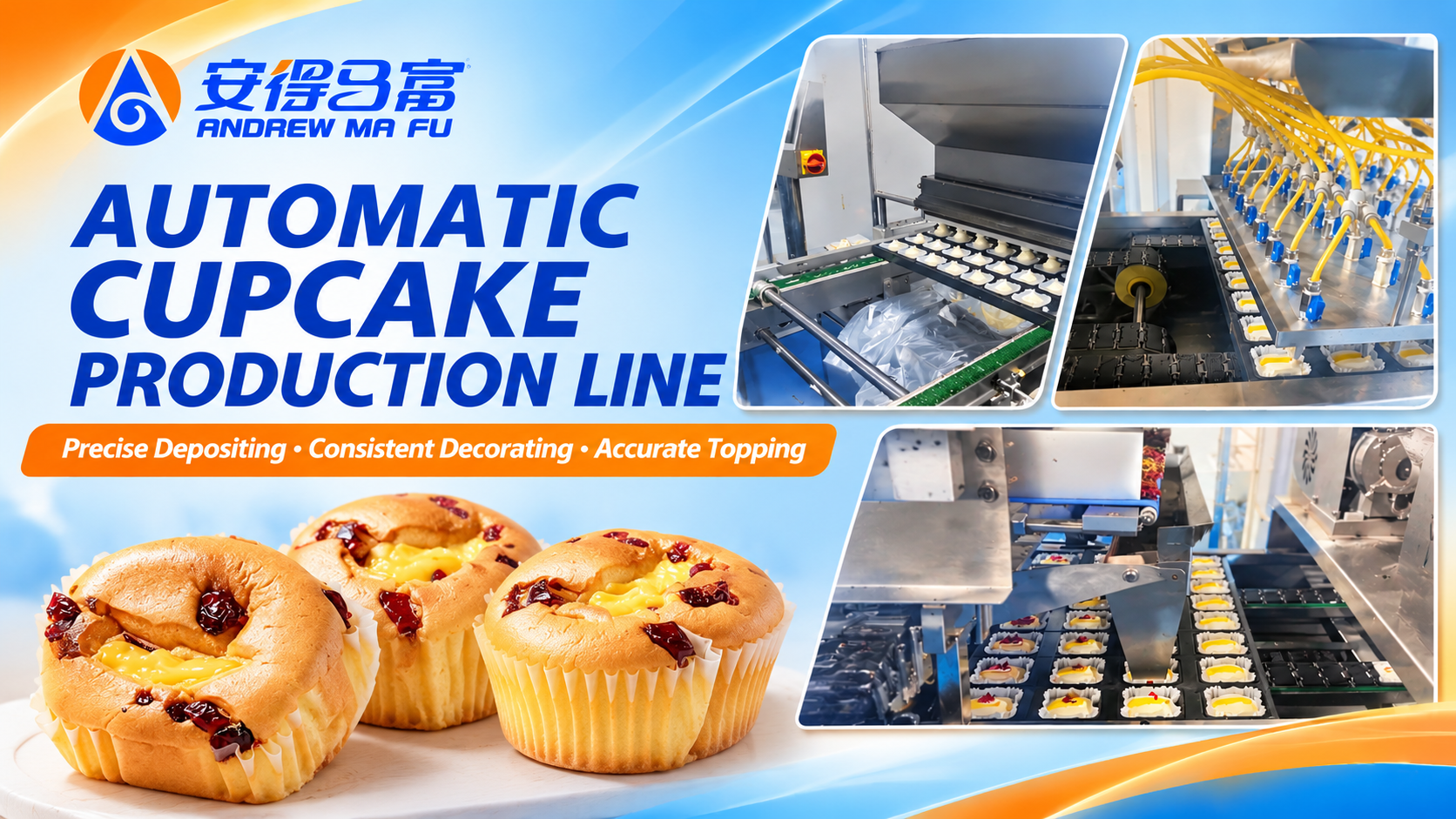
In the competitive global bakery and snack food sector, commercial bakeries and industrial food processors face unprecedented pressure to balance soaring production volumes with uncompromising product consistency. Single-serve baked goods—particularly gourmet cupcakes, muffins, and portioned sponge cakes—continue to see robust market demand across retail supermarket chains, convenience stores, and foodservice franchises. However, traditional manual or semi-automated processing methods create severe operational bottlenecks: uneven batter weights, inaccurate topping distribution, labor-intensive paper cup placement, and high scrap rates.
To overcome these manufacturing hurdles, Andrew Mafut masini (ADMF) introduces its next-generation automatic cupcake production line. Designed specifically for high-capacity industrial bakeries, this fully integrated, continuous processing solution synchronizes every crucial stage of cupcake manufacturing—from automatic paper cup denesting and high-precision batter depositing to artistic frosting piping and targeted dry topping dispensing. By replacing fragmented manual handling with synchronized servo-driven automation, the production line empowers bakery enterprises to drastically reduce labor overhead, eliminate raw material giveaway, and achieve flawless product uniformity at scale.
As highlighted in our latest factory demonstration video (Watch YouTube Showcase), this turnkey system delivers continuous, high-speed output while maintaining the artisanal aesthetic quality that premium retail buyers demand.
The Industrial Imperative: Why Bakeries Must Automate Cupcake Production
Scaling cupcake production manually or with disjointed semi-automatic units introduces significant operational liabilities:
(1)Escalating Labor Expenses & Operator Fatigue: Placing individual paper baking cups into multi-cavity pans and manually piping frosting require large assembly teams. These repetitive manual tasks are prone to human fatigue, leading to inconsistent product visual quality and high staff turnover.
(2)Ingredient Waste from Inaccurate Dosing: Slight overfills in batter deposition or excess sprinkle spillage quickly compound into thousands of dollars in lost profit margins over annual production runs.
(3)Food Hygiene & Cross-Contamination Risks: Frequent direct manual contact with open food trays and ingredients increases microbiological risks, complicating compliance with global food safety standards.
(4)Throughput Bottlenecks: Inability to match the high-speed continuous feeding requirements of industrial tunnel ovens or rotary rack oven loading schedules.
Le automatic cupcake production line from Andrew Mafut masini directly resolves these vulnerabilities through fully closed-loop mechanical synchronization, smart PLC recipe controls, and hygienic engineering design.
Comprehensive Engineering Breakdown: 4 Core Modules
The ADMF automated cupcake line operates as a modular, conveyor-synchronized continuous manufacturing platform. Each functional unit is engineered with high-precision servo controls and food-grade stainless steel architecture:
1. Automatic Paper Cup / Tray Dispenser
The line begins with the automated denesting and positioning of paper cupcake liners into commercial baking trays or multi-cavity moulds.
(1)Precision Vacuum Suction: Utilizes multi-head pneumatic vacuum cups driven by high-response linear actuators to separate single paper cups from nested stacks reliably without crushing or tearing delicate fluted paper.
(2)Accurate Cavity Alignment: Synchronized with the indexing conveyor, the unit drops liners directly into the center of each tray cavity at high speeds.
(3)Versatile Tooling: Quick-change dispensing magazines accommodate diverse cup geometries, including standard fluted liners, tulip muffin wraps, square paper trays, and aluminum foil baking cups.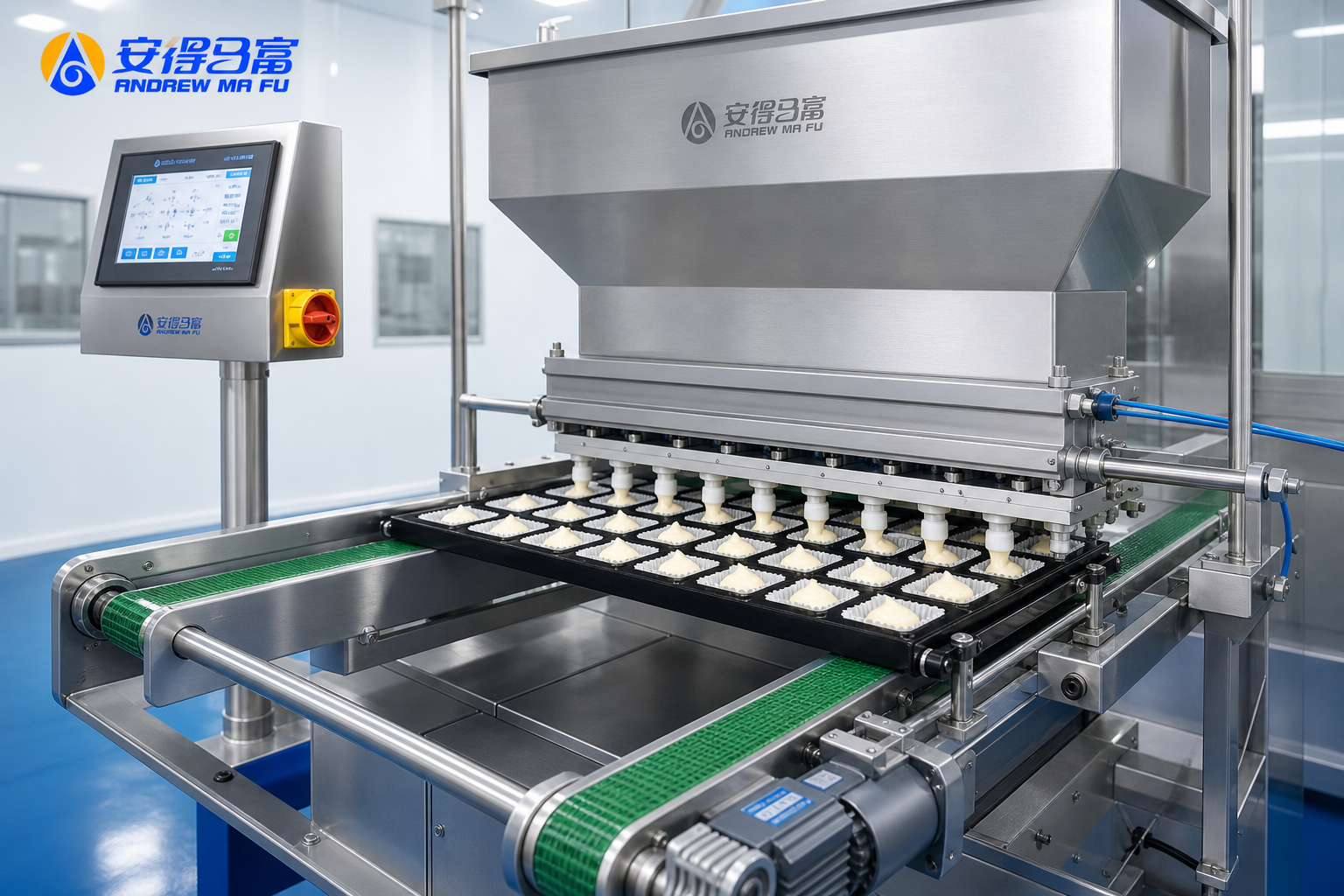
2. Servo-Driven Cupcake Batter Depositor
Accurate batter volumetric control is the foundation of uniform baking, consistent rise, and uniform crumb structure. For broader liquid dough processing solutions, explore our advanced bread and cake depositor machines.
(1)Volumetric Piston Metering: Driven by precision servo motors, each dispensing nozzle features an independent rotary valve and volumetric cylinder, ensuring consistent gram-weight accuracy across all tray rows.
(2)Anti-Drip & Clean Cut-Off Nozzles: Positive shut-off dive nozzles plunge into the cups during dosing and pull back with a synchronized suck-back stroke, eliminating tailing, dripping, and tray contamination.
(3)Gentle Product Handling: The hopper and manifold geometries protect delicate aerated sponge batters, dense muffin doughs, and particulate inclusions (such as blueberries or chocolate chips) from shear damage.
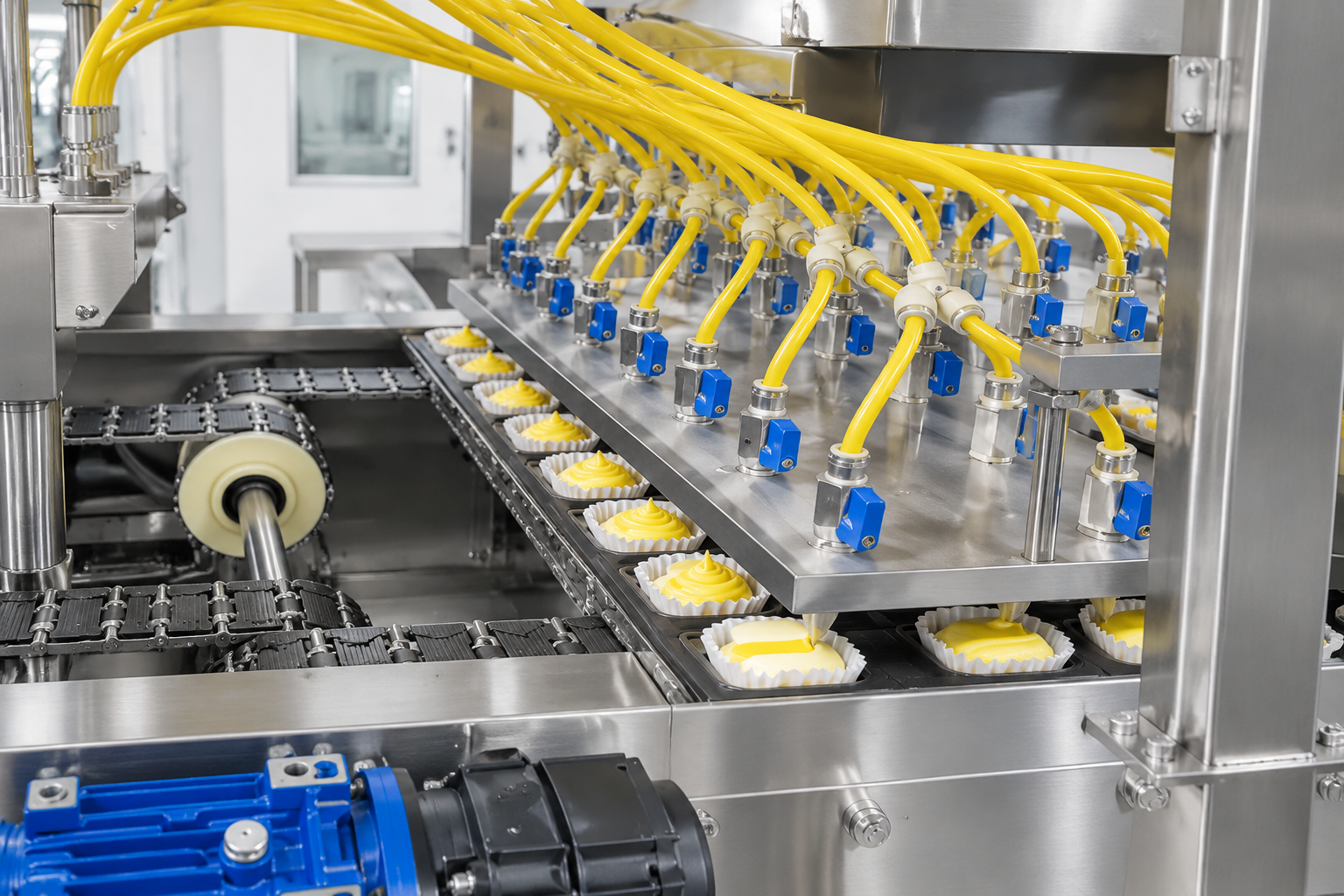
3. Automated Cake Decorating / Frosting / Piping Machine
Post-baking and cooling, cupcakes are seamlessly conveyed into the automatic decorating cell to receive rich frostings, buttercreams, whipped icings, or chocolate ganache.
(1)Multi-Axis Servo Motion: Capable of executing intricate programmable motion profiles—such as classic spiral rosettes, top center star mounds, zigzag ribbons, and multi-layer dome swirls.
(2)Center Injection & Surface Piping Capability: The dual-function head can perform internal custard/jam core injection as well as exterior decorative frosting simultaneously or sequentially.
(3)Recipe-Driven Quick Changeovers: Operators select stored decorating patterns directly on the color touchscreen HMI, shifting styles in seconds without mechanical disassembly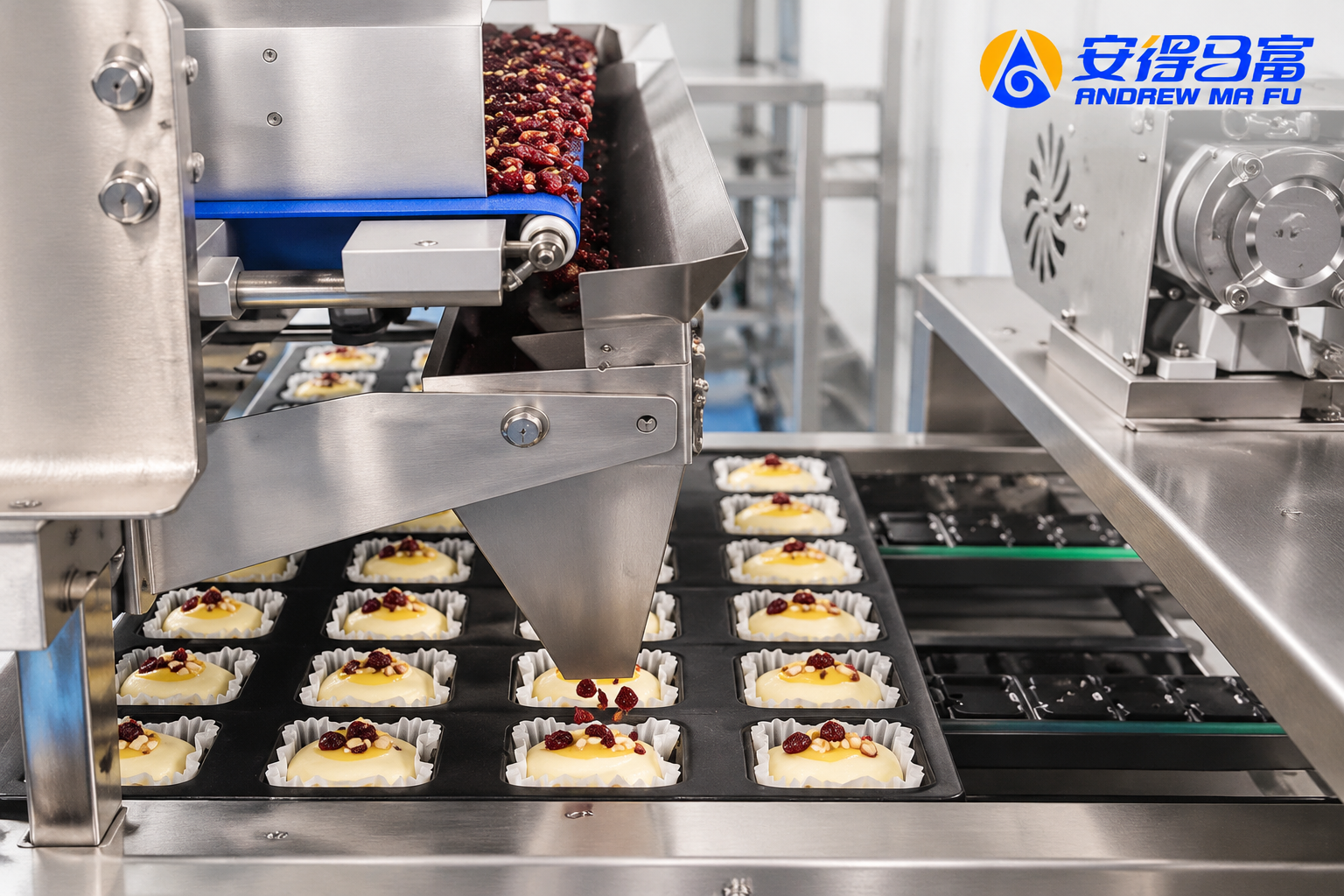
4. Positioned Quantitative Topping / Sprinkling Machine
The final touch of visual elegance is applied by the specialized quantitative topping dispenser, ensuring consistent garnish distribution without product waste.
(1)Optical Sensor-Triggered Dispensing: High-speed photo-sensors detect the precise location of incoming cupcakes, triggering targeted dry ingredient discharge only when a product is directly underneath.
(2)Uniform Quantitative Scattering: Vibratory or rotary metering drums evenly scatter diverse dry toppings, including chocolate flakes, rainbow sprinkles, crushed nuts, desiccated coconut, and crystalline sugars.
(3)Excess Ingredient Recovery System: Integrated stainless steel collection troughs catch overspray between cup positions, enabling hygienic recycling and keeping the conveyor surface pristine.
Synchronized Automated Process Flow
The seamless operation of the Andrew Mafut masini cupcake line ensures maximum overall equipment effectiveness (OEE):
(1)Tray Infeed & Indexing: Empty commercial baking pans (e.g., 400×600 mm, 600×800 mm, or custom sizes) enter via the heavy-duty stainless steel continuous conveyor.
(2)Synchronized Cup Loading: The paper cup dispenser places an entire row or matrix of cups simultaneously.
(3)Precision Batter Deposition: Trays advance under the depositor; the diving nozzles descend, deposit the exact batter volume, and retract cleanly.
(4)Thermal Processing (Baking & Cooling): Trays transition into baking systems (such as tunnel or rotary ovens) and subsequent cooling spirals.
(5)Automated Surface Decoration: Cooled cupcakes are indexed under the piping unit, which applies custom frosting designs.
(6)Targeted Top Dressing: The topping machine dispenses precise amounts of decorative sprinkles onto the fresh frosting.
(7)Packaging Integration: Finished cupcakes proceed smoothly to automatic outfeed, flow wrapping, or clamshell blister packaging stations.
For industrial plants seeking complete facility automation, this system integrates effortlessly alongside our simple bread production lines and specialized pastry equipment.
Key Operational & Technical Advantages
Unmatched Gram-Weight Accuracy & Product Uniformity
By employing individual servo motor drives for the depositing piston bank, the line achieves remarkable weight tolerances (typically within ±1% variation depending on batter viscosity). Consistent volume guarantees uniform baking times, identical crumb expansion, and standardized packaging weights.
Maximum Labor Reduction & High Throughput
A traditional manual cupcake preparation and decorating line requires 8 to 12 operators to de-nest liners, weigh batter scoops, hand-pipe buttercream, and apply toppings. The ADMF automated system reduces the required line staffing to just 1 or 2 operators for hopper replenishment and tray monitoring, cutting labor overhead by up to 75%.
Food-Grade Sanitary Construction & Easy Maintenance
Built entirely from premium food-grade AISI 304/316 stainless steel and FDA-approved food-contact polymers, the entire production line adheres to international hygienic design standards.
(1)Hopper units, depositor manifolds, and piping nozzles feature tool-free quick-release clamps for rapid daily sanitation.
(2)Washdown-resistant electrical enclosures (IP65/NEMA 4X) protect sensitive electronics during high-pressure cleaning cycles.
Intuitive PLC Recipe Management & Flexibility
The centralized Siemens / Delta PLC system stores up to 100 distinct production recipes. Operators can seamlessly switch between standard breakfast muffins, birthday cupcakes, filled molten lava cakes, and seasonal holiday specialties with a single tap on the multi-language touchscreen.
Technical Specification Matrix (Reference Overview)
The following parameters outline the flexible engineering capabilities of the ADMF industrial cupcake platform.
*Note: Specifications above are indicative. All machinery dimensions, nozzle layouts, stroke rates, and power configurations are custom-engineered based on the customer’s specific product recipes, tray formats, and target plant output.
Realizing Superior Return on Investment (ROI)
Investing in an automated cupcake processing line delivers substantial, quantifiable financial returns for growing food enterprises:
(1)Direct Labor Cost Savings: Reallocating 6 to 10 workers from manual depositing and piping tasks yields immediate payroll savings, frequently allowing capital equipment payback within 8 to 14 months.
(2)Raw Material Optimization: Eliminating batter drippage on pan borders and overfilling saves an estimated 2% to 4% in premium ingredient costs annually.
(3)Expanded Market Reach: Consistent product aesthetic, uniform frosting peaks, and precise shelf-ready presentation open lucrative vendor contracts with tier-1 supermarket chains and export distributors.
Partner with Andrew Mafu Machinery for Your Bakery Automation
With over 15 years of dedicated engineering excellence in commercial bakery and food processing machinery, Andrew Mafut masini provides complete turnkey automated solutions tailored to your unique market ambitions. Operating from our 20,000-square-meter modern manufacturing facility in Zhangzhou, our team of 300+ professionals and 100+ technical service specialists serves clients across more than 120 countries and regions worldwide.
Whether you are upgrading an existing cupcake production facility or designing a brand-new automated bakery plant from the ground up, our engineering experts are ready to deliver customized layout blueprints, recipe testing, and end-to-end commissioning support.
Ready to elevate your bakery’s production capacity and product consistency?
Contact Our Global Sales Team: Faʻafesoʻotaʻi Andrew Mafa Maketi
Imeli: [email protected]
Explore More Solutions: ADMF Official News & Case Studies
Masani ona fesiligia fesili (faq)
Q1: What types of cupcake and muffin batters can the ADMF depositor handle?
A: The ADMF servo depositor handles a comprehensive spectrum of batter viscosities—from light, aerated sponge cake batters and chiffon mixes to heavy, dense muffin doughs. It can also deposit batters containing soft particulate suspensions (such as chocolate chips, raisins, dried cranberries, and fruit pulp) without crushing the inclusions.
Q2: Can the paper cup dispenser handle different shapes and sizes of baking cups?
A: Yes. The dispenser magazine and vacuum suction tooling are fully modular. Quick-change changeover parts allow the machine to denest standard fluted cupcake liners, elegant tulip-style muffin paper, rectangular loaf cups, and pre-formed foil trays. Changeovers typically take under 10 minutes.
Q3: What frosting types and decorating patterns can the piping machine execute?
A: The multi-axis servo decorating system is compatible with buttercreams, fresh dairy cream, vegetable whipped toppings, chocolate ganache, and royal icing. Standard software presets include classic concentric rosettes, upright star peaks, continuous zig-zags, flat top spreads, and dual-color swirls. Custom piping paths can also be programmed via the touchscreen.
Q4: How is the production line cleaned and sanitized between recipe changes?
A: Hygienic design is a cornerstone of Andrew Mafut masini equipment. The batter hopper, piston cylinders, liquid manifolds, and topping hoppers feature quick-release tri-clamp connections for tool-free disassembly. All food-contact parts can be washed down quickly or transferred to CIP (Clean-In-Place) wash stations, minimizing changeover downtime.
Q5: Can this cupcake production line be integrated into an existing tunnel oven?
A: Absolutely. Our engineering team designs the infeed and outfeed conveyors to match your existing pan conveyor heights, oven indexing speeds, and factory floor layouts (including linear, L-shaped, or U-shaped floorplans).
Q6: What is the typical lead time and international commissioning support?
A: Standard customized lines require approximately 45 to 60 days for precision fabrication, assembly, and rigorous pre-shipment factory testing. ADMF provides comprehensive global support, including on-site engineer dispatch for installation, line commissioning, electrical integration, and operator training across 120+ countries.
Q7: How can I request a customized quotation and layout drawing for my factory?
A: Simply reach out to our technical sales team via our online contact portal or email [email protected] with your target hourly capacity, tray dimensions, and product samples. Our engineering department will provide a tailored 2D/3D plant layout and formal quotation within 24–48 hours.
References & Industry Standards
- Food and Agriculture Organization (FAO) — Food Safety & Quality Standards: https://www.fao.org/food-safety/en/
- Codex Alimentarius — General Principles of Food Hygiene: https://www.fao.org/fao-who-codexalimentarius/en/
- U.S. Food and Drug Administration (FDA) — Food Manufacturing Guidelines: https://www.fda.gov/food
- Bakerpedia — Industrial Cake & Cupcake Processing Knowledge Base: https://bakerpedia.com/
- Baking Business (Sosland Publishing) — Global Bakery Production Trends: https://www.bakingbusiness.com/
- European Hygienic Engineering & Design Group (EHEDG) — Hygienic Equipment Guidelines: https://www.ehedg.org/
- AIB International — Food Safety & Bakery Process Standards: https://www.aibinternational.com/

E ala i le faafanua