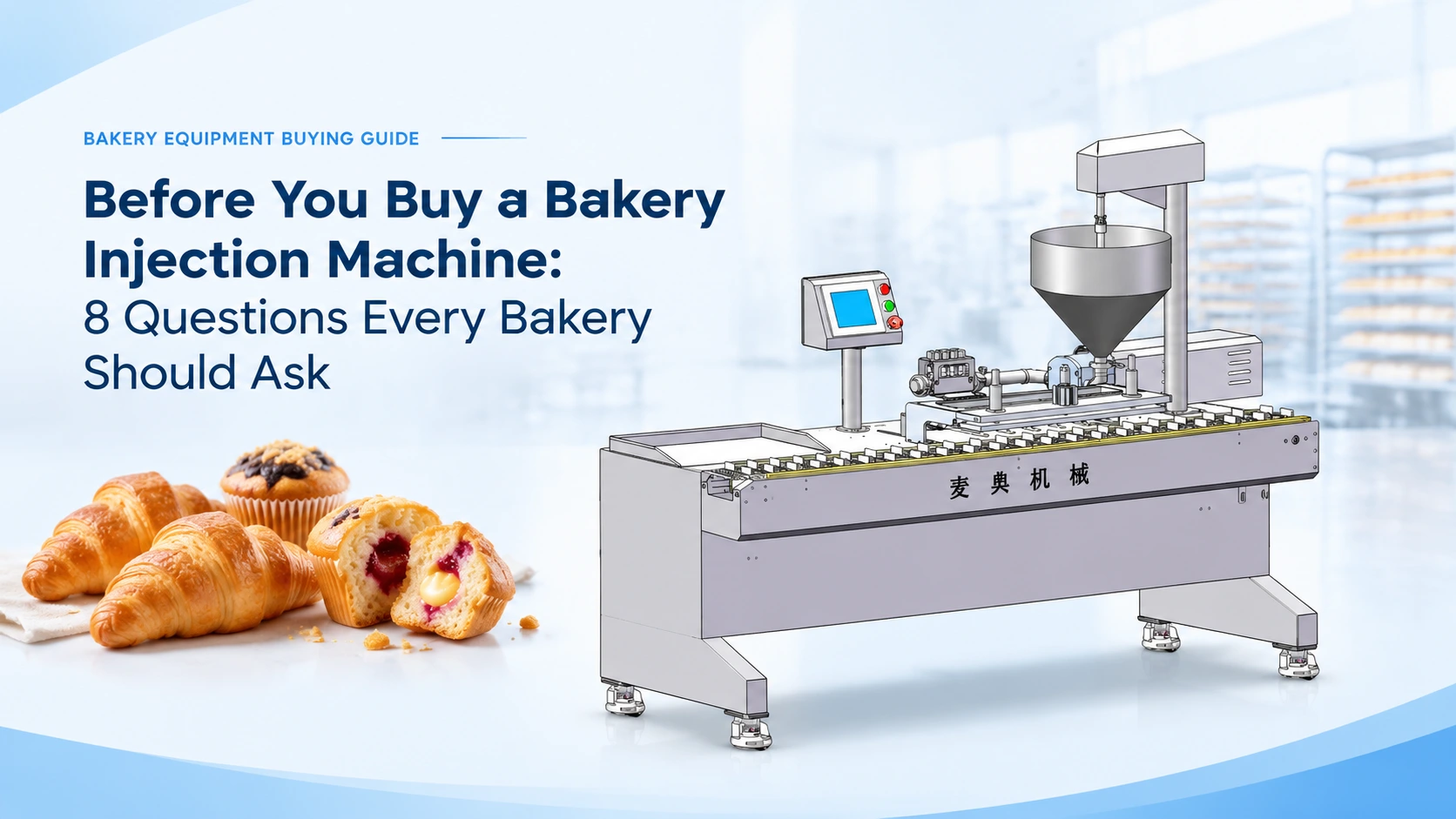
Choosing the right bakery injection machine is an important investment for bakeries looking to improve product consistency, increase output, and reduce manual labor. Whether you manufacture cream-filled buns, muffins, cupcakes, croissants, or other filled bakery products, the right equipment can help streamline production and maintain consistent quality.
However, not every injection machine is suitable for every product or filling. Factors such as filling viscosity, product structure, target output, dosing accuracy, and cleaning requirements can significantly affect machine performance.
Before requesting a quotation, every bakery should consider the following eight questions.
1. Which Bakery Products Do You Need to Fill?
Start by identifying the products you manufacture. Different products require different injection methods and machine configurations.
For example, muffins and cupcakes may require vertical injection from the top, while croissants, bread rolls, and eclairs may be better suited to side injection. Some applications require filling products on trays, while others need continuous conveyor operation.
GEA offers both top and side injection systems for different bakery applications, demonstrating why product shape and processing method should guide equipment selection.
Before purchasing, provide the manufacturer with product photos, dimensions, weight, and details of the existing production process.
2. What Type of Filling Will You Use?
The filling material directly influences the injection system, pump design, nozzle size, and cleaning process.
Common bakery fillings include:
(1)Whipped cream and custard
(2)Jam and fruit fillings
(3)Chocolate and chocolate cream
(4)Sauces and other pumpable fillings
(5)Thick or semi-dense fillings
Some fillings are sensitive to temperature, while others contain particles or have a high viscosity. These characteristics may require special nozzles, temperature control, or a suitable dosing mechanism.
Ask the supplier whether the machine can handle your actual recipe under production conditions. A filling test using your material is more reliable than choosing equipment based on product names alone.
3. What Production Capacity Do You Need?
Calculate your required output in pieces per hour or trays per hour. Consider both current demand and expected business growth.
A semi-automatic machine may be suitable for a small bakery or a business with frequent product changes. Larger manufacturers may benefit from automatic tray handling, multi-nozzle injection, or integration with a conveyor production line.
Remember that advertised capacity is not always the same as actual output. Filling volume, product spacing, nozzle quantity, tray dimensions, operator speed, and cleaning downtime can all affect production.
Request a capacity estimate based on your specific product and filling weight rather than relying only on a general maximum figure.
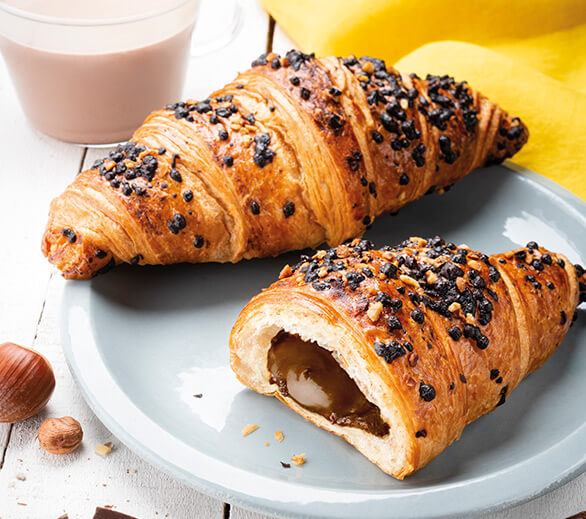
4. How Accurate Must the Filling Dose Be?
Consistent filling weight is important for product quality, cost control, and portion consistency.
Volumetric piston systems can deliver controlled doses, while servo-driven systems may provide additional control over injection movement and settings. The best choice depends on the filling characteristics and the accuracy your production process requires.
Ask the supplier about adjustable dosing ranges, repeatability, and how the machine performs with your actual filling. Also confirm whether the quoted accuracy is a tested result, a target value, or a specification under defined conditions.
5. Can the Machine Handle Different Products and Recipes?
If your bakery manufactures several product types, flexibility should be a key purchasing consideration.
Check whether the machine supports adjustable dosing volume, interchangeable nozzles, adjustable injection positions, and recipe settings. Quick-change components can reduce downtime when switching between products or fillings.
For bakeries planning future expansion, discuss whether additional nozzles, automatic loading, or integration with upstream and downstream equipment can be added later.
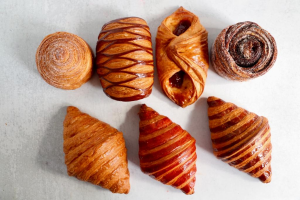
6. How Easy Is the Machine to Clean?
Food hygiene is essential when working with cream, custard, chocolate, jam, and other fillings. Residue can remain in hoses, pumps, pistons, nozzles, and product-contact areas if cleaning is difficult.
Ask which components can be removed for cleaning, what cleaning procedure is recommended, and whether tools are required for disassembly. Confirm the materials used in food-contact areas and the availability of replacement seals and other wear parts.
Some industrial systems offer clean-in-place (CIP) options, while other machines rely on manual cleaning. The appropriate solution depends on the machine design, filling material, and factory hygiene procedures.
7. Will the Machine Integrate with Your Existing Production Line?
A standalone injection machine may be sufficient for manual production. An automated factory may need synchronization with conveyors, cooling tunnels, tray systems, or packaging equipment.
Confirm the conveyor height, belt or tray dimensions, product spacing, electrical supply, compressed-air requirements, and control-system compatibility before installation.
If you plan to expand automation in stages, discuss the future layout with the manufacturer before finalizing the machine configuration.
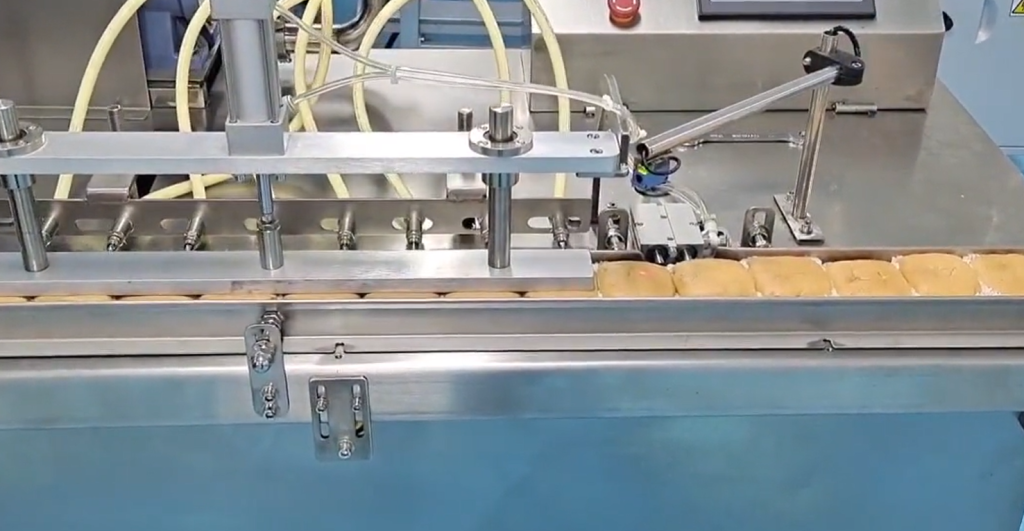
8. What Are the Total Costs Beyond the Purchase Price?
The purchase price is only one part of the investment. Consider installation, operator training, spare parts, cleaning time, maintenance, energy consumption, and expected downtime.
Ask what is included in the quotation, which parts are considered consumables, how technical support is provided, and what warranty terms apply.
A machine with a lower initial price may not offer the best long-term value if it is difficult to clean, unsuitable for your filling, or unable to meet your production target.
Technical Parameter Reference Table
The following table illustrates parameters from a published Formex semi-automatic injector brochure. These are reference specifications for that machine, not universal requirements or specifications for Andrew Mafu Machinery equipment. Actual performance depends on the product, filling, tray layout, and configuration.
| Technical Parameter | Published Reference Specification | Why It Matters |
| Dosing range | 3–45 cc | Helps determine whether the machine can deliver the required filling volume |
| Number of nozzles | 4–5 | Influences the number of injection points per cycle |
| Tray width | 40–45 cm | Must match the production tray or handling system |
| Example tray format | 40 × 60 cm | Helps evaluate compatibility with the product layout |
| Example filling cycle | One tray in 28 seconds | Provides a reference for estimating throughput under stated conditions |
| Dosing control | Mechanical | Affects how dosing adjustments are made |
| Filling type | Liquid or semi-dense filling materials | Must be verified against the actual recipe |
The example cycle time should not be treated as a guaranteed production rate. Actual output varies with filling quantity, product characteristics, tray loading, and operating conditions.
Faaiuga
Buying a bakery injection machine should begin with your product and production requirements—not simply the machine price or advertised speed.
By answering these eight questions, you can communicate more clearly with equipment manufacturers and compare solutions on a like-for-like basis. For a more accurate recommendation, prepare your product photos, filling type, required dose per piece, target capacity, and available factory utilities before requesting a quotation.
Andrew Mafu Machinery provides bakery equipment and automated production-line solutions. Sharing your production requirements helps the team evaluate a suitable configuration for your application.
FAQ
1. What products can a bakery injection machine fill?
Depending on its design and configuration, an injection machine may fill muffins, cupcakes, croissants, cream buns, eclairs, and other suitable bakery products. Product compatibility should be confirmed through testing.
2. Can one machine handle different fillings?
Some machines can handle several fillings, but viscosity, particles, temperature, and cleaning requirements may limit compatibility. Confirm the supported filling range with the manufacturer.
3. Is a semi-automatic or fully automatic injection machine better?
A semi-automatic machine may suit smaller production volumes and frequent product changes. Fully automatic equipment is often more appropriate when output requirements are higher or the injection process must be integrated into a production line.
4. What information is needed for a quotation?
Provide product type and dimensions, filling material, target filling weight, required hourly output, preferred injection method, and factory power and compressed-air conditions.
5. How can I evaluate dosing accuracy?
Ask for the specified dosing range, repeatability data, and test results using your actual filling. Confirm the test conditions and acceptable weight variation before placing an order.
References
1.GEA – Piston Filling Injectors — Overview of bakery injection technologies and applications.
2.GEA – Cakes and Pastry Top Injectors — Information on volumetric injection systems and bakery applications.
3.GEA – Cakes and Pastry Side Injectors — Side injection systems, automation options, and filling applications.
4.Formex – Semi-Automatic Injector Catalogue — Published example specifications for a semi-automatic injector.

E ala i le faafanua