How to Choose Bakery Equipment: A Complete Buying Guide for Industrial Bakeries
2026-07-09
As the global bakery industry continues to expand, investing in the right bakery equipment has become one of the most important decisions for food manufacturers. Whether you are launching a new bakery, expanding production capacity, or upgrading an existing factory, selecting suitable equipment directly affects product quality, production efficiency, operating costs, and long-term profitability.
Industrial bakery equipment is no longer limited to simple mixers and ovens. Modern production lines integrate intelligent automation, precise dough processing, energy-efficient baking systems, and automated packaging to achieve stable, continuous production. Choosing equipment based only on price often leads to higher maintenance costs, lower productivity, and inconsistent product quality.
AtAndrew Mafu Machinery, we have helped bakery manufacturers in many countries build customized production lines for bread, toast, hamburger buns, hot dog buns, croissants, and other baked products. This guide explains the key factors every bakery should consider before investing in industrial bakery equipment.
Understand Your Production Requirements First
Before comparing different suppliers, clearly define your production goals.
Important questions include:
1.What bakery products will you manufacture?
2.What is the expected hourly or daily production capacity?
3.What are the dimensions and weight of each product?
4.Will you produce one product or multiple varieties?
5.How much factory space is available?
6.What level of automation is required?
The answers determine the overall production line configuration and equipment specifications.
Select Equipment Based on Product Type
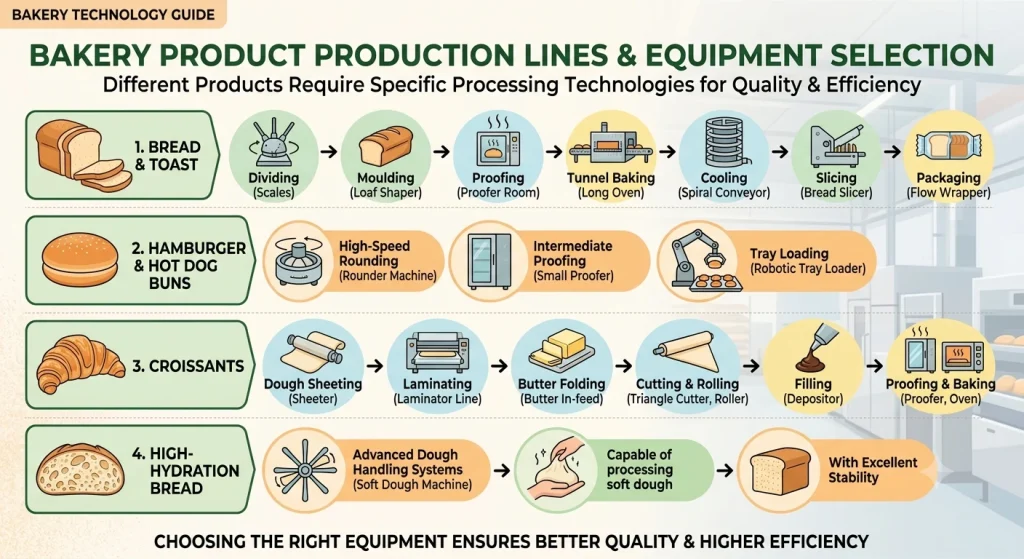
Different bakery products require different processing technologies.
For example:
1.Bread and Toast require accurate dividing, moulding, proofing, tunnel baking, cooling, slicing, and packaging.
4.High-Hydration Bread requires advanced dough handling systems capable of processing soft dough with excellent stability.
Choosing equipment specifically designed for your products ensures better quality and higher efficiency.
Consider Automation Level
Modern bakeries generally choose one of three production models:
Automation Level
Suitable For
Advantages
Semi-Automatic
Small bakeries
Lower investment and flexible production
Automatic
Medium-sized factories
Balanced productivity and labor savings
Fully Automatic
Industrial bakeries
Maximum efficiency, stable quality, and minimal manual operation
Fully automatic production lines reduce labor dependence while improving consistency and food safety.
Evaluate Equipment Quality
High-quality bakery equipment should be manufactured using food-grade materials and reliable components.
Key considerations include:
1.SUS304 stainless steel construction
2.Food-grade conveyor belts
3.Servo motor positioning
4.PLC control system
5.Touchscreen HMI
6.Easy cleaning design
7.Stable electrical components
8.CE-compliant safety design
Premium components improve reliability and reduce maintenance costs over the equipment’s service life.
Key Technical Specifications
The following table shows typical technical specifications for a modern industrial bakery production line.
Parameter
Typical Specification
Production Capacity
2,000–12,000 pcs/hour
Product Weight
30–800 g
Dough Hydration
55–85%
Machine Material
SUS304 Stainless Steel
Control System
Mitsubishi PLC + Touch Screen
Servo Motors
Mitsubishi / Delta
Inverter
Schneider Electric
Operating Voltage
220V / 380V / 415V (Customized)
Frequency
50Hz / 60Hz
Proofing Temperature
35–40°C
Proofing Humidity
75–85% RH
Tunnel Oven Temperature
180–260°C
Conveyor Belt
Food-grade PU Belt
Safety Design
CE Standard
Actual specifications can be customized according to customer requirements.
Energy Efficiency Matters
Energy consumption has become a major operating cost for industrial bakeries.
When selecting equipment, evaluate:
1.Efficient heating systems
2.Insulated tunnel ovens
3.Variable frequency drives (VFD)
4.Servo-controlled motors
5.Intelligent standby functions
6.Heat recovery options
Energy-efficient equipment reduces operating expenses and supports sustainable manufacturing.
Flexibility for Future Expansion
Many bakeries begin with a limited product range but later expand into new markets.
Choose equipment that allows:
1.Multiple product sizes
2.Recipe storage
3.Quick changeovers
4.Additional forming modules
5.Future automation upgrades
A modular production line protects your investment and simplifies future expansion.
After-Sales Service Is Just as Important
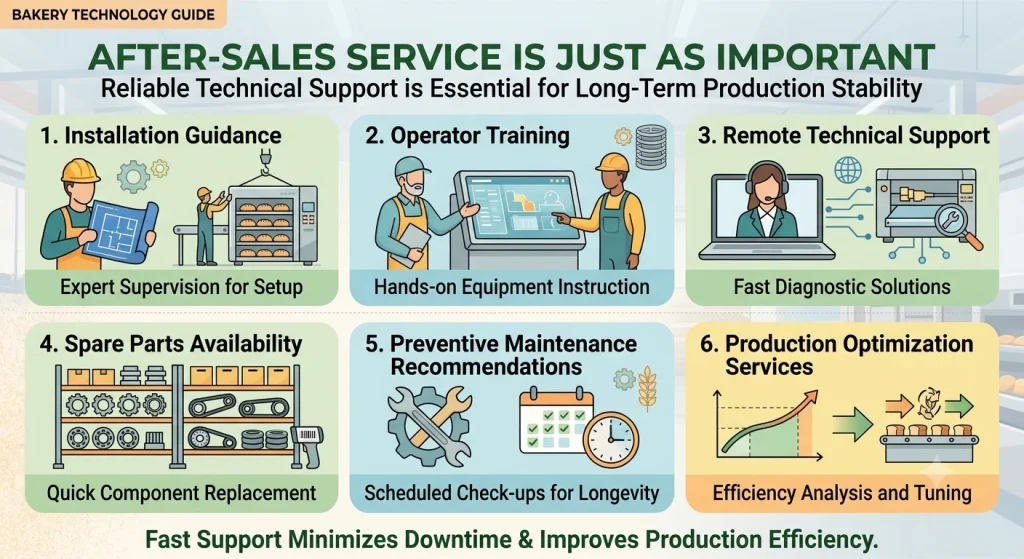
Reliable technical support is essential for long-term production stability.
Before purchasing equipment, verify whether the supplier provides:
1.Installation guidance
2.Operator training
3.Remote technical support
4.Spare parts availability
5.Preventive maintenance recommendations
6.Production optimization services
Fast support minimizes downtime and improves production efficiency.
Why Choose Andrew Mafu Machinery?
Andrew Mafu Machinery focuses on providing complete industrial bakery solutions rather than individual machines.
Our advantages include:
1.Customized production line design
2.Professional engineering consultation
3.Advanced PLC automation
4.High-quality international electrical components
5.Flexible production configurations
6.Stable equipment performance
7.Comprehensive technical support
8.Global project experience
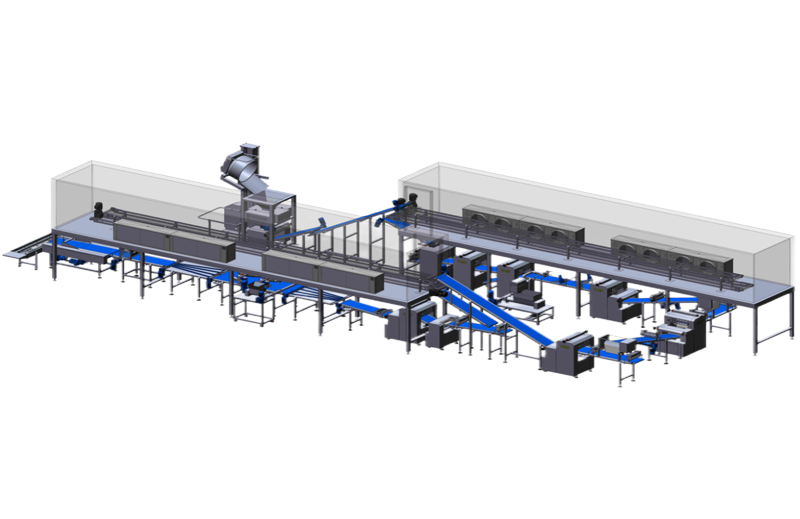
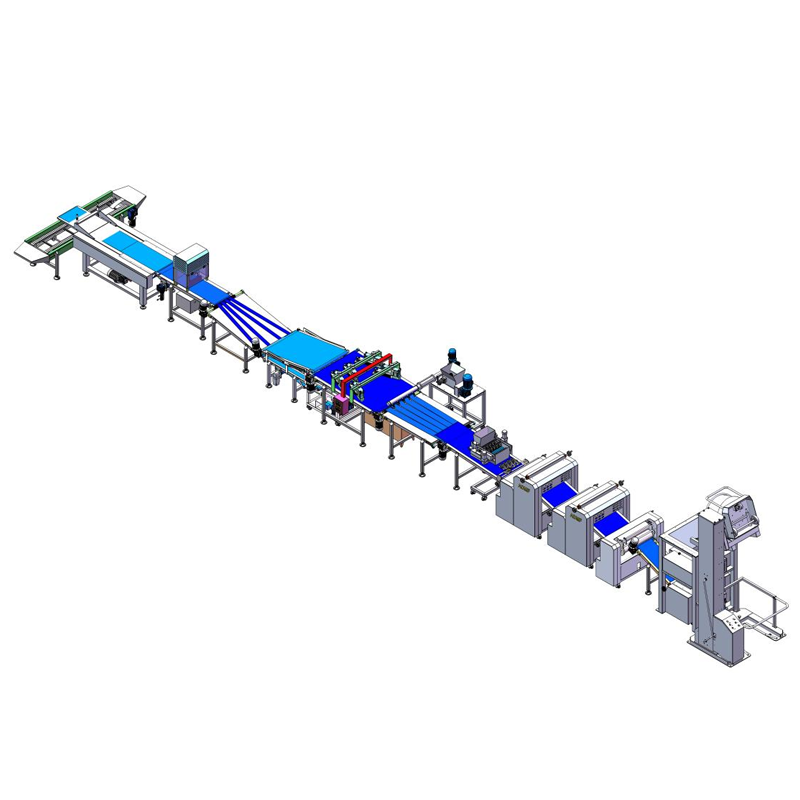
Whether producing sandwich bread, toast, buns, croissants, or specialty bakery products, our engineering team designs equipment to match each customer’s production requirements and factory layout.
Conclusion
Choosing bakery equipment is a strategic investment that influences production efficiency, product consistency, operating costs, and future business growth. The best solution is not always the least expensive—it is the one that delivers reliable performance, flexibility, energy efficiency, and long-term value.
By carefully evaluating production requirements, automation level, equipment quality, technical specifications, and after-sales support, bakery manufacturers can build a production line that remains competitive for years to come.
Andrew Mafu Machinery is committed to helping bakeries worldwide achieve intelligent, efficient, and sustainable production through customized industrial bakery equipment solutions.
1. What equipment is required for a complete bread production line?
A complete line typically includes a mixer, dough resting system, dough divider, rounder, intermediate proofer, moulder, final proofer, tunnel oven, cooling conveyor, slicer, and packaging machine.
2. How do I determine the right production capacity?
Capacity should be selected according to your daily output target, production shifts, available factory space, and future expansion plans.
3. Is fully automatic equipment worth the investment?
Yes. Fully automatic systems reduce labor costs, improve consistency, enhance food safety, and increase overall productivity, making them a cost-effective long-term investment.
4. Can one production line produce different bakery products?
Yes. Modular designs allow manufacturers to switch between different product sizes and types with appropriate tooling and recipe adjustments.
5. Does Andrew Mafu Machinery provide customized solutions?
Yes. Every production line is designed according to product specifications, production capacity, factory layout, utility requirements, and local electrical standards.