Manual vs Automatic Croissant Production: Which Solution Is Better for Modern Commercial Bakeries?
2026-07-31
Croissants have become one of the most popular premium bakery products worldwide, valued for their buttery aroma, flaky layers, and crisp exterior. Traditionally, croissants were produced entirely by hand. While this handcrafted process produces authentic pastries, it is labor-intensive and difficult to scale.
Modern commercial bakeries now face increasing pressure to improve efficiency, maintain consistent product quality, reduce labor costs, and meet rising consumer demand. As a result, automatic croissant production lines have become the preferred solution for medium and large-scale manufacturers.
But is automation always the better choice? Are manual methods still suitable for certain operations? This guide compares manual and automatic croissant production, helping bakery manufacturers choose the most appropriate solution.
Understanding the Croissant Production Process
Regardless of production scale, croissant manufacturing follows the same basic process:
1.Dough Mixing
2.Dough Resting
3.Butter Laminating
4.Multi-stage Folding
5.Dough Sheeting
6.Triangle Cutting
7.Croissant Rolling/Forming
8.Proofing
9.Egg Washing (Optional)
10.Baking
11.Cooling
12.Packaging
The main difference lies in how these steps are performed—manually or through automated equipment.
Manual Croissant Production
Manual production relies heavily on skilled bakers and traditional techniques.
Typical equipment includes: Spiral dough mixer, Manual pastry sheeter, Cutting templates, Hand rolling tables, Proofing cabinet, Deck oven.
Each croissant is shaped individually, allowing experienced bakers to adjust dough handling according to texture and environmental conditions.
Challenges: High labor costs, Slow production speed, Product inconsistency, Dependence on skilled workers, Difficult production planning.
Automatic Croissant Production
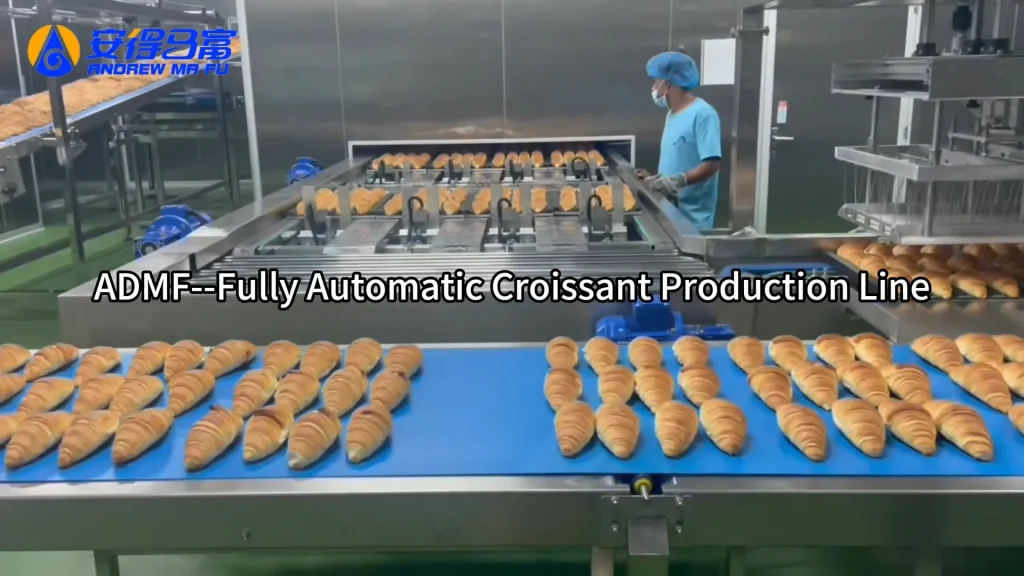
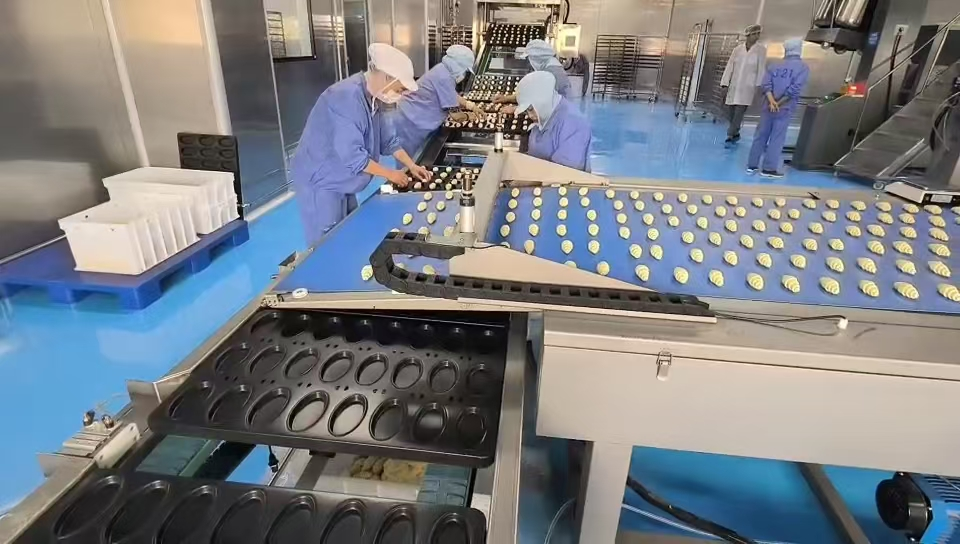
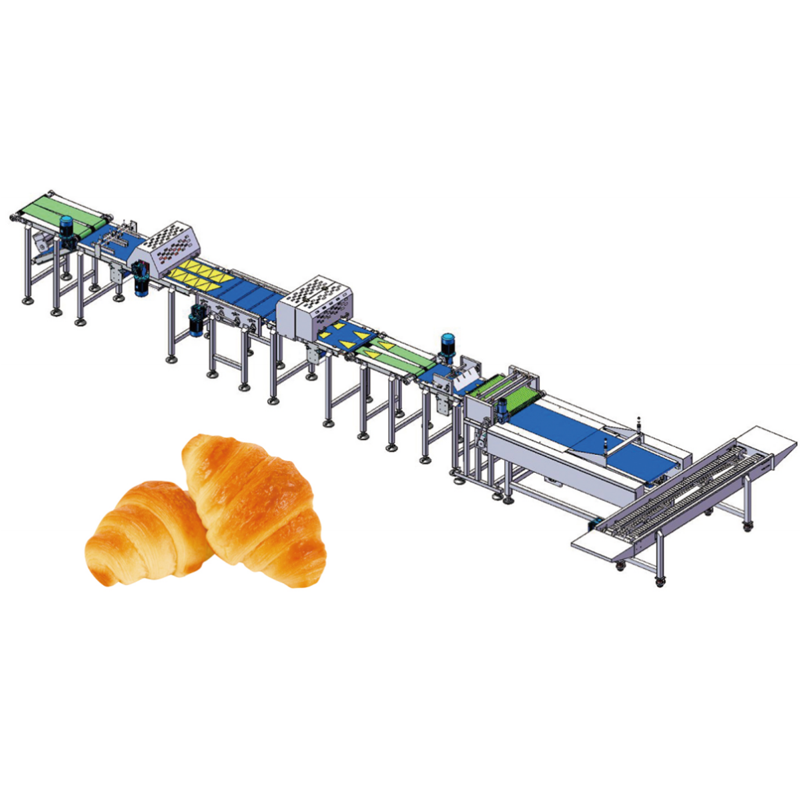
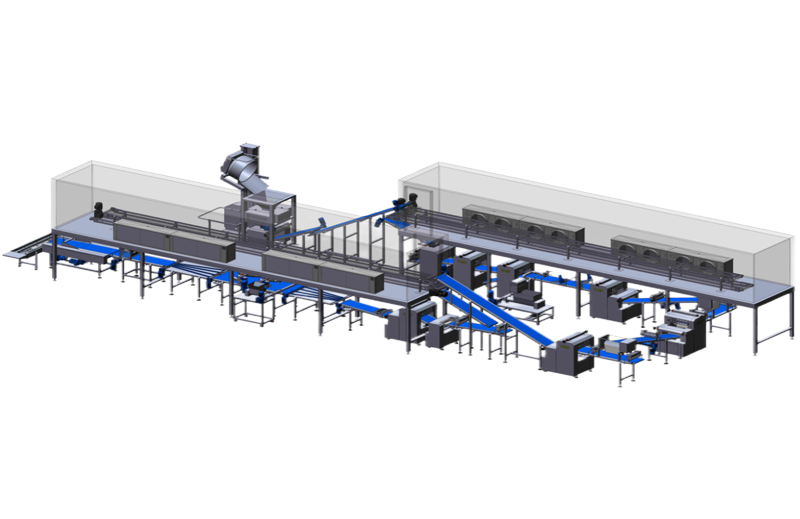
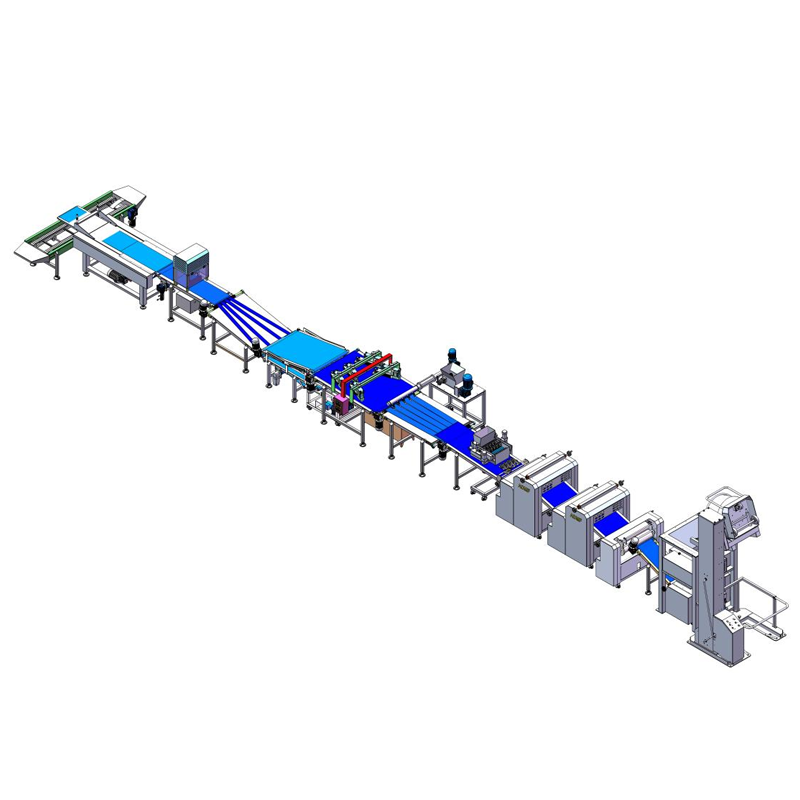
Automatic production integrates multiple machines into a continuous processing line.
A typical automatic croissant production line includes:
1.Dough feeding system
2.Laminating machine
3.Pastry sheeter
4.Servo-controlled reduction rollers
5.Triangle cutting module
6.Automatic croissant forming machine
7.Conveyor transfer system
8.Proofing solution
9.Baking equipment
10.Cooling conveyor
11.Packaging line
Manual vs Automatic Production Comparison
The following table highlights the major differences between manual and automatic croissant production.
Comparison Item
Manual Production
Automatic Production
Production Capacity
300–800 pcs/hour
3,000–12,000 pcs/hour
Labor Requirement
8–15 operators
2–5 operators
Product Consistency
Depends on operator
Highly consistent
Dough Thickness Accuracy
Manual adjustment
±0.2 mm Servo Control
Product Weight Accuracy
±5 g
±1 g
Waste Rate
Higher
Lower
Food Safety
Operator dependent
Controlled production
Recipe Storage
Manual
PLC Memory
Product Changeover
Slow
Fast
Operating Cost
High
Lower over time
The comparison demonstrates that automation offers significant advantages in consistency, efficiency, and operational control.
Typical Technical Parameters of an Automatic Croissant Production Line
When selecting equipment, manufacturers should evaluate technical specifications in addition to production capacity.
Item
Typical Specification
Production Capacity
3,000–12,000 pcs/hour
Dough Sheet Width
600–1,200 mm
Dough Thickness
2–30 mm (Adjustable)
Croissant Weight Range
30–120 g
Servo Control Accuracy
±0.2 mm
Cutting Accuracy
±1 mm
Laminating Layers
Up to 81 Layers
Conveyor Speed
5–25 m/min
Installed Power
30–80 kW
Machine Material
SUS304 Stainless Steel
Control System
Siemens PLC + HMI
Air Pressure
0.6 MPa
Voltage
380V / 50Hz / 3 Phase
Conveyor Belt
Food-grade PU Belt
Safety Features
Emergency Stop, Safety Covers, Light Curtains
Product Quality Comparison
Consistency is one of the biggest advantages of automation.
In manual production, differences in rolling pressure, dough thickness, and shaping techniques can lead to: Uneven layers, Different croissant sizes, Irregular baking results, Variable butter distribution.
Automatic systems solve these issues through:
1.Servo-controlled sheeting
2.Precision laminating
3.Automatic cutting
4.Consistent rolling tension
5.Digital recipe management
This produces croissants with uniform size, identical layers, and stable baking performance.
Labor Cost Comparison
Labor shortages have become a significant challenge for bakeries worldwide. Manual production requires experienced workers who understand laminated dough processing.
Automation reduces dependence on manual skills by:
1.Automatically feeding dough
2.Controlling sheeting thickness
3.Cutting identical dough triangles
4.Rolling croissants consistently
5.Synchronizing production speed
Many industrial bakeries reduce labor requirements by more than 60% after upgrading to an automatic croissant production line.
Return on Investment (ROI)
Although automatic production requires a higher initial investment, long-term savings are substantial.
Key financial benefits include:
1.Lower labor costs
2.Higher production capacity
3.Reduced material waste
4.Fewer defective products
5.Lower maintenance through predictive servicing
6.Improved energy efficiency
For medium and large bakeries, the typical payback period for an automatic croissant production line ranges from 18 to 36 months, depending on production volume and local labor costs.
Which Solution Is Best for Your Bakery?
The right choice depends on production goals.
Manual production is suitable for: Artisan bakeries, Boutique cafés, Small daily production volumes, Specialty or seasonal products.
At Andrew Mafu Machinery , Automatic production is recommended for: Industrial bakeries, Central kitchens, Frozen croissant manufacturers, Supermarket suppliers, Hotel and catering suppliers, Export-oriented food factories.
Automation is especially valuable when demand is consistent and high-volume production is required.
Future Trends in Croissant Manufacturing
The bakery industry is rapidly embracing digital manufacturing and smart automation.
Emerging technologies include:
1.AI-assisted recipe optimization
2.IoT-enabled production monitoring
3.Predictive maintenance systems
4.Vision inspection for product quality
5.Automated data collection and traceability
6.Energy consumption monitoring
7.Remote diagnostics and cloud-based production management
These innovations help manufacturers improve efficiency, maintain consistent product quality, and respond quickly to changing market demands.
Conclusion
Both manual and automatic croissant production have their place in today’s bakery industry. Manual methods preserve the artisan character valued by boutique bakeries, while automatic production provides the speed, consistency, and scalability required for commercial manufacturing.
For growing bakery businesses, investing in an automatic croissant production line is more than an equipment upgrade—it is a strategic investment in efficiency, product quality, food safety, and long-term competitiveness. By selecting the right production solution based on capacity, product range, and business objectives, manufacturers can position themselves for sustainable growth in an increasingly competitive bakery market.
1. How many croissants can an automatic production line produce?
Depending on the configuration, most industrial lines can produce 3,000 to 12,000 croissants per hour, with some customized systems offering even higher capacities.
2. Does automation reduce product quality?
No. Modern automatic croissant production lines are designed to preserve laminated dough structure while delivering consistent weight, shape, and layer quality.
3. What is the biggest advantage of automation?
Automation improves production efficiency, consistency, labor utilization, food safety, and long-term operating costs while enabling large-scale manufacturing.
4. How long does it take to recover the investment?
Most commercial bakeries achieve a return on investment within 18–36 months, depending on production volume, labor savings, and equipment utilization.
5. Can automatic lines produce different croissant sizes?
Yes. PLC-controlled systems allow operators to store multiple recipes and adjust product weight, dimensions, and forming parameters with minimal downtime.