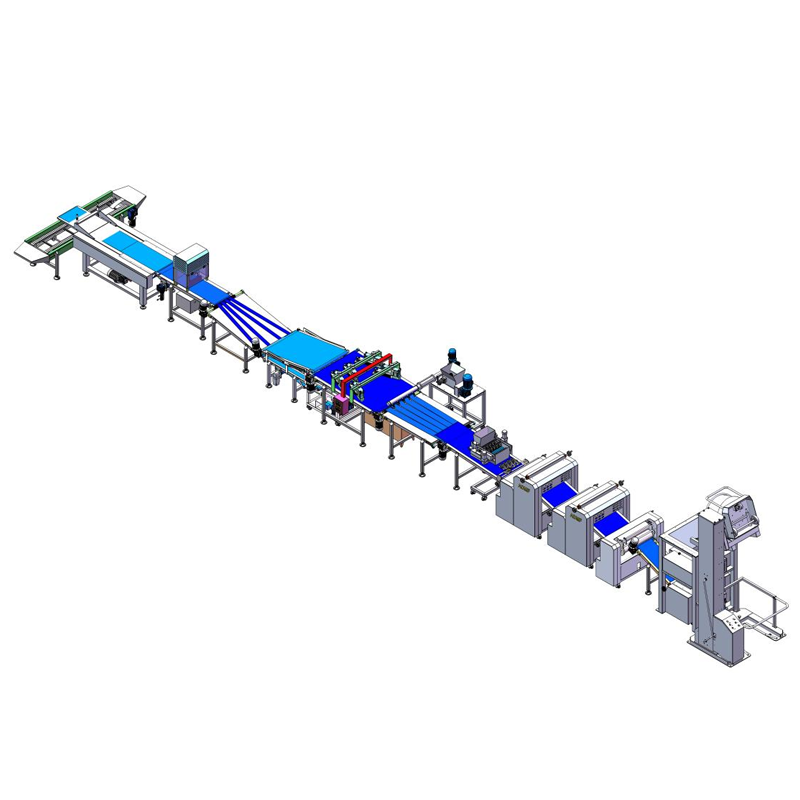
How an Automatic Pocket Bread Production Line Works: Complete Guide for Bakeries
2026-08-13
What Is an Automatic Pocket Bread Production Line?
An Automatic Pocket Bread Production Line is a specialized bakery automation system designed to convert prepared toast bread into finished pocket bread products.
Unlike conventional bread production lines that start with flour and dough, this production solution starts with finished toast bread. The production line focuses on the precise handling and processing of toast slices.
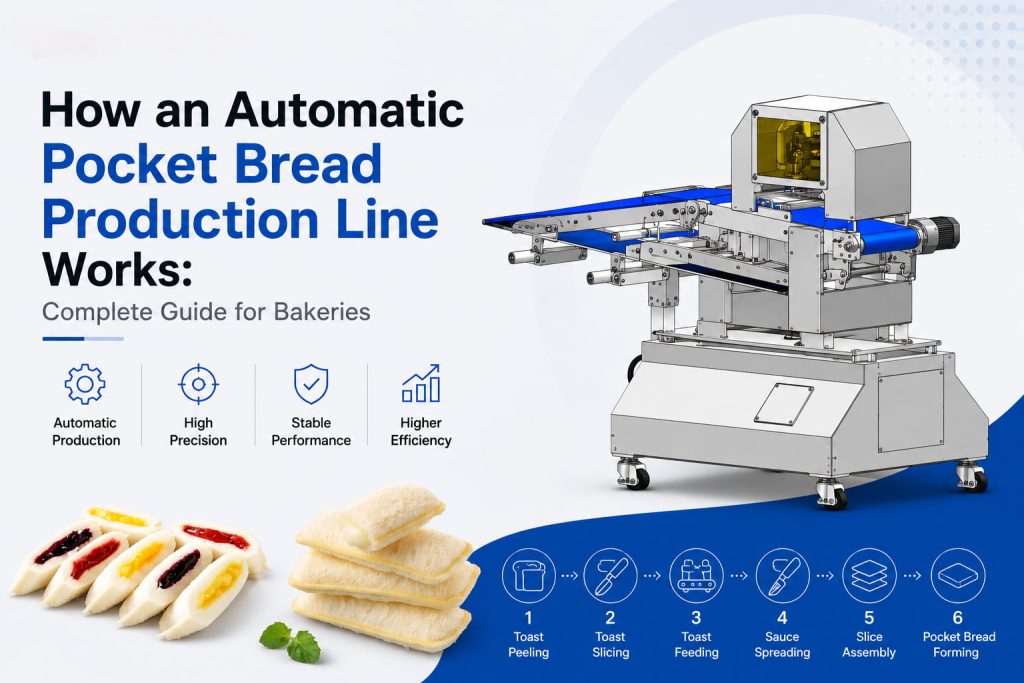
The complete production process can be divided into six major stages:
By connecting these machines with conveyors and synchronized control systems, the entire process can be operated continuously.
This is particularly suitable for bakeries and food manufacturers producing filled toast products, pocket sandwiches, snack bread, and other customized bakery products.
Main Production Steps:
Step 1: Toast Bread Peeling
The first stage is toast bread peeling. After the toast bread has been baked and cooled, the crust needs to be removed before further processing. A Toast Peeling Machine automatically removes the outer crust from the toast.
Compared with manual peeling, an automatic peeling system can provide more consistent processing and reduce labor requirements. The machine can be configured with adjustable processing conditions according to the size and thickness of the toast.
Typical features may include:
1.304 stainless steel frame
2.Automatic toast conveying
3.High-speed peeling mechanism
4.Adjustable processing parameters
5.Food-grade conveyor belts
6.Continuous production operation
Step 2: Toast Slicing
After peeling, the toast enters the Toast Slicing Machine. The purpose of this stage is to divide the peeled toast into uniform slices suitable for subsequent assembly.
Consistent slice thickness is important because variations can influence the final pocket bread structure. The slicing machine can be synchronized with upstream and downstream conveyors, allowing the toast to move continuously through the production line.
For industrial applications, automatic slicing can provide several advantages:
1.Consistent slice thickness
2.Reduced manual handling
3.Continuous production
4.Improved production efficiency
5.Easier integration with downstream equipment
Step 3: Automatic Toast Feeding
The Toast Feeding Machine is responsible for accurately transferring individual toast slices to the next processing position. This stage is particularly important because the toast needs to be correctly positioned before sauce spreading and assembly.
An automated feeding system can use conveyors, sensors, and positioning mechanisms to control the spacing and orientation of the toast slices.
This reduces problems such as:
1.Incorrect positioning
2.Overlapping slices
3.Uneven spacing
4.Manual feeding errors
5.Production interruptions
Step 4: Sauce or Slurry Spreading
After the toast slices are positioned, the next stage is sauce spreading.
The spreading system applies the required sauce, slurry, filling material, or other food ingredients onto the toast surface. Depending on the customer’s product recipe, the system can be configured for different materials.
The objective is to achieve consistent distribution while controlling the amount of material applied. For industrial production, controlled spreading is important because excessive or insufficient material can affect the final product’s appearance, weight, taste, and assembly performance.
The spreading equipment can therefore be designed around parameters such as:
1.Spreading width
2.Material viscosity
3.Application quantity
4.Conveyor speed
5.Product dimensions
Step 5: Toast Slice Assembly
The next stage is toast slice assembly. At this point, the system accurately combines the processed toast slices according to the required product structure.
The assembly process needs to maintain consistent alignment between the slices.
An automatic assembly system can help control:
1.Slice positioning
2.Product alignment
3.Layer arrangement
4.Conveyor spacing
5.Product transfer
This is one of the key differences between a manual sandwich-making process and an industrial automated production system. Instead of workers manually positioning every slice, the automated system performs the operation continuously according to preset parameters.
Step 6: Automatic Pocket Bread Forming
After assembly, the product enters the most important stage: the Automatic Pocket Bread Machine.
The machine performs the final forming process and transforms the assembled toast product into the required pocket bread shape. The forming process needs to apply controlled pressure and accurate positioning without excessively damaging the bread.
The final product can then be transferred to downstream equipment for inspection, packaging, or other processing.
This final forming stage gives the production line its name: Automatic Pocket Bread Production Line.
Reference Technical Parameters
The following table provides reference parameters for a customized automatic pocket bread production system. Actual specifications should be confirmed according to the customer’s toast size, product structure, sauce characteristics, required capacity, and factory layout.
Note: The specifications above are reference values for SEO and technical communication. Final machine parameters should be confirmed according to the customer’s product samples and production requirements.
Advantages of an Automatic Pocket Bread Production Line
Integrating six major processing stages into one production line significantly reduces repeated manual handling.
2.Consistent Product Quality
Automated positioning, spreading, slicing, and forming help maintain more consistent products throughout production.
3.Reduced Labor Requirements
The automatic system minimizes repetitive manual operations and allows operators to focus on production monitoring and quality control.
4.Better Process Synchronization
Each machine can be connected through conveyors and control systems, allowing upstream and downstream equipment to work together.
5.Flexible Product Configuration
The production line can be customized according to toast dimensions, product size, sauce application requirements, and final pocket bread specifications.
Hygienic Design for Industrial Bakery Production
Because the production line handles ready-to-eat or partially processed bakery products, hygienic equipment design is an important consideration.
Codex guidance recommends that food-contact equipment be designed so it can be adequately cleaned, disinfected, maintained, and inspected. It also recommends suitable, durable and non-toxic materials for food-contact applications.
For this reason, bakery production equipment can incorporate stainless-steel construction, food-grade conveyor belts, accessible components, and practical machine layouts to support routine cleaning and maintenance.
Who Should Consider This Production Line?
An Automatic Pocket Bread Production Line is suitable for:
1.Industrial bakeries
2.Commercial bakeries
3.Sandwich manufacturers
4.Foodservice suppliers
5.Bakery product manufacturers
6.Ready-to-eat food producers
7.Large-scale toast processing factories
It is especially useful for manufacturers that already produce toast bread and want to develop higher-value finished products using an automated downstream processing system.
Instead of purchasing completely separate machines and manually transferring products between each process, manufacturers can integrate the complete workflow into a coordinated production line.
Conclusion
The Automatic Pocket Bread Production Line from Andrew Mafu Machinery is designed around a practical and highly automated production workflow:
Each stage performs a specific function, while the complete system works together through conveyors and automated control. For bakeries looking to increase production efficiency, reduce manual handling, and achieve more consistent pocket bread products, an integrated production line can provide a scalable solution.
Andrew Mafu Machinery can customize the equipment configuration according to toast dimensions, product specifications, sauce application requirements, production capacity, factory layout, and automation level, providing bakery manufacturers with a complete solution from individual machines to integrated production lines.
FAQ
1.Is the production line suitable for industrial bakeries?
Yes. The integrated design is particularly suitable for commercial and industrial manufacturers that require continuous production, consistent product quality, and reduced manual handling.
Yes. The spreading system can be configured according to the type, viscosity, application quantity, spreading width, and recipe requirements of the customer’s sauce or slurry.
4. Can the production line handle different toast sizes?
The equipment can be customized according to the dimensions and specifications of the customer’s toast products. Product samples are recommended when determining the final configuration.
5. Can the line be connected to packaging equipment?
Yes. The finished pocket bread can be transferred through downstream conveyors and connected with inspection, counting, packaging, or other processing equipment according to the complete production plan.